


The first time James heard the footsteps, he blamed the building.
It was an old brick apartment on the south side of Portland, the kind with thin walls, rattling pipes, and a super named Gary who answered every complaint with, “That’s just the building settling.” James had lived there for six months and had learned to settle along with it.
But footsteps were different.
They came at 3:07 a.m., always from the third-floor hallway, always slow, like someone pacing outside his door. Not running. Not knocking. Just walking.
James would wake with his mouth dry and his phone glowing in the dark. He’d lie there, listening, until the sound faded into the hum of the refrigerator downstairs.
The second night, he got up and checked the hallway.
Empty.
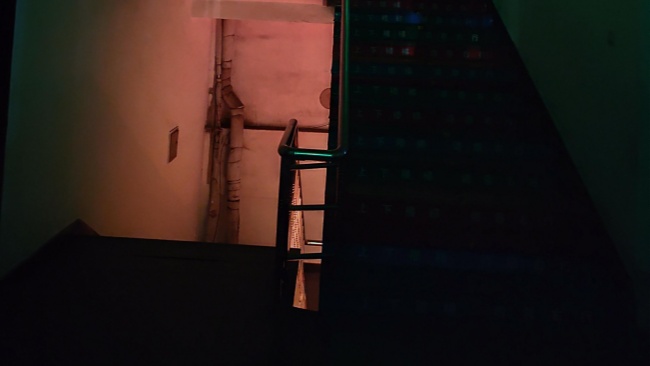
The fluorescent light flickered above him, casting pale rectangles on the scuffed carpet. A child’s red mitten lay near the stairwell. James didn’t remember seeing it before. He picked it up, turned it over in his hands, and set it on the radiator by the lobby door.
By the third night, he was angry.
He called Gary.
“There’s someone walking up and down the third floor at three in the morning,” James said. “Kids, probably. Or some idiot with hard-soled shoes.”
Gary sighed. “Nobody lives in 3B anymore. Place has been empty since spring.”
James didn’t like the way that sounded.
That night, he left his door cracked open an inch and sat on the couch with a baseball bat across his knees. The apartment was too quiet. Even the street outside seemed to hold its breath.
At 3:07, it began.
Soft at first. Then clearer.
Step. Pause. Step.
It stopped outside his door.
James didn’t move. His pulse thudded in his ears. The footsteps waited with him, as if they had always known he would listen.
Then came a small sound.
A knock.
Not loud. Not threatening. Just two gentle taps, like a child asking to come in from the rain.
James stood so fast the bat clattered to the floor. He crossed the hallway in three steps and yanked the door open.
Nothing.
Only the empty corridor, the buzzing light, and that same red mitten lying beside his doormat.
He picked it up. The wool was damp, though it hadn’t rained in days.
The next afternoon, James went to the leasing office. The woman behind the desk, Marcy, had kind eyes and a habit of tapping her pen against her teeth when she thought.
“3B,” she repeated. “You’re sure that’s where it’s coming from?”
“I’m sure someone’s up there.”
She hesitated, then pulled a folder from the cabinet. “The last tenant was a woman named Helen Carr. She had a son. Little boy, maybe six.”
James felt the mitten in his coat pocket. He had meant to throw it away. He hadn’t.
“What happened?” he asked.
Marcy’s pen stopped tapping. “She moved out suddenly. Spring, like Gary said. But there was talk. Nothing confirmed. The boy went missing for a few hours one night. They found him in the building’s old laundry room, asleep on a pile of towels. Cold, but okay.”
James stared at the folder. “Why is 3B empty now?”
“Helen said the place didn’t feel safe anymore. I don’t blame her.”
That night, James didn’t wait for 3:07.
He climbed the stairs at three flat, bat in hand, heart beating too loud in his chest. The third-floor hallway smelled faintly of dust and lemon cleaner. The door to 3B was locked, its number crooked on the frame.
He pressed his ear to the wood.
Silence.
Then, from inside, a tiny scrape. Like a toy being dragged across the floor.
James stepped back. He told himself to call the police. He told himself a lot of things.
Instead, he knocked.
“Hello?” he said. His voice sounded foolish in the empty hall. “Is someone in there?”
No answer.
He turned to leave.
The knock came from inside 3B.
Two gentle taps.
James froze. The hallway light buzzed above him. Somewhere below, a door closed. He wanted to walk away, to go back to his apartment and pretend he had imagined the whole thing.
But the mitten in his pocket felt heavier than it should.
He knocked again.
“I’m not going to hurt you,” he said. “I just want to know you’re okay.”
Nothing.
Then, very softly, a child’s voice came through the door.
“Are you the new neighbor?”
James’ breath caught. “Yeah,” he said. “I’m James. I live downstairs.”
A pause.
“My mom says new neighbors are supposed to bring cookies.”
James almost laughed. Almost cried. He wasn’t sure which frightened him more.
“I don’t have cookies,” he said. “But I can bring some tomorrow.”
The voice was small and tired. “Okay.”
He stood there for a long time, listening to the silence behind the door. He didn’t know if he should call Gary, or Marcy, or someone with a key. He didn’t know if what he had heard was real.
But he went downstairs anyway.
The next evening, James baked cookies. He wasn’t a baker. The kitchen looked like a storm had passed through it, and the cookies came out slightly burnt around the edges. He put them on a paper plate, wrapped them in foil, and climbed the stairs.
The third-floor hallway was quiet.
The door to 3B was still locked.
He set the plate on the floor outside it and knocked twice.
“I brought cookies,” he said.
No voice answered.
He waited, then went back downstairs.
The next morning, the plate was gone.
In its place sat the red mitten, neatly folded beside a small smear of crumbs.
James picked it up and held it for a long time. He didn’t tell anyone. He wasn’t sure anyone would believe him, and part of him didn’t want them to.
The footsteps never came again.
But sometimes, when James passed the third-floor hallway, he thought he caught the faint smell of cookies in the air.
And once, just before sleep, he heard two soft knocks from somewhere far away, like a thank-you delivered through the walls.
He never knocked back.
Some doors, he realized, are better left open just enough to be kind—without ever needing to see who stands on the other side.