

Journey Never Tells You Who You Are. That’s Why It Haunts Grown-Ups.
A short essay about a game with no dialogue, and the one moment it treats loneliness like something gentle instead of a bug.
I played Journey for the first time ten years ago on a laptop with a cracked hinge. Second time last November, at 1:40 a.m., after a month of saying “I’m fine” to people who could tell I wasn’t.
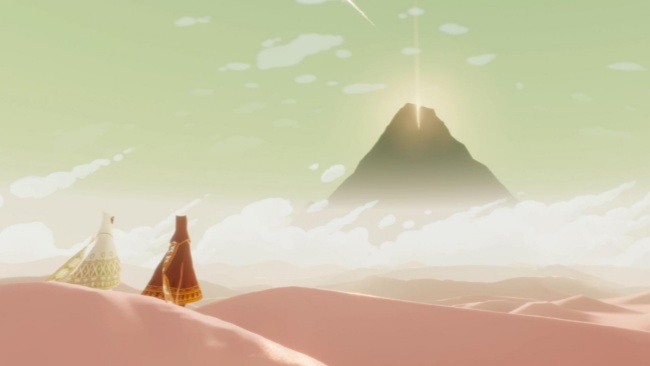
Nothing happens in that game. You spawn on sand. You walk. Sometimes you glide. A stranger in a red cloak appears beside you—random, server-matched, no mic, no names, no way to ask them to stay.
And here’s the thing that wrecked me the second time around:
It never lets you talk.
Not because it’s shy. Because it knows something most games—and most offices, most friendships—get wrong. It knows that the moment you explain yourself, the other person starts performing back. A “me too.” A nod. A small polite rescue. And suddenly you’re not being held anymore. You’re being managed.
So Journey does the braver thing. You can only emit a note. One tone. You hover near someone, your scarves brush, and you both keep going. No promises. No let’s be friends. Just: I’m here beside you for the stretch of this hill, and then the server splits us and neither of us owes the other an apology.
That’s not a gameplay mechanic. That’s a boundary lesson dressed as sand.
I replayed the snow chapter slowly this time. Not to finish fast—I kept stopping at the part where you’re small, tiny against white, and the music drops to almost nothing. Most games would fill that silence with a quest marker. Journey leaves it empty on purpose.
Empty is where I lived for most of last year. Not crashing. Just… untranslated. Things happening to me that I couldn’t shape into a sentence that wouldn’t sound needy. So I’d put the game on in the background like a lamp, and let a character who cannot speak to me be alone with me without trying to fix it.
That’s the trick it pulls at the end, too.
No epilogue. No cutscene where your companion turns around and smiles so you know it was meaningful. The credits roll, you dissolve into dust, and the game gently lies to you in the most loving way possible: it doesn’t confirm that the connection was real—it just lets you walk away having felt it.
Real things don’t always announce themselves. Sometimes they’re the ten seconds where nobody asked you to perform.
I closed the game that night and didn’t cry. I just sat there a while—the way you sit after someone holds the door for you and you realize you didn’t have to shrink to get through it.
If you’re the kind of adult who’s good at surviving and bad at being held: this game is three hours long and it will not ask anything of you.
It’ll just stay beside you up the hill. Then vanish. And somehow that’s the kindest goodbye I’ve had in a long time.