


James had been a night patrol officer for twelve years.
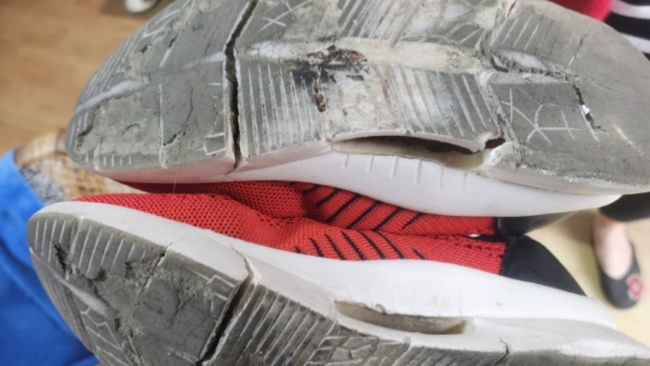
He didn’t wear the job like a uniform; he wore it like a second skin. The badge on his chest was polished, the radio clipped neatly to his shoulder, but the shoes—those were the only thing that told the truth. The left sole had begun to peel away near the toe, and the right heel had worn down so thin he could feel every crack in the pavement.
His supervisor had told him three times to put in a request for new boots.
“James, you look like you’re walking through a war zone,” she’d said.
But James never did. He told himself it was because the old shoes were broken in. The truth was quieter than that. He liked the way they reminded him he had walked every corner of this neighborhood, every alley, every stairwell, every bus stop where someone might be waiting for help that never came.
On a cold Tuesday night, he was assigned to patrol the riverside housing complex. It was an older building, twelve stories of brick and faded paint, with elevators that groaned and hallway lights that flickered like tired eyes. A call had come in around midnight: a child reported missing.
James arrived to find the mother sitting on the curb, wrapped in a blanket that didn’t belong to her. Her name was Elena. She had dark hair pulled into a messy bun and hands that wouldn’t stop shaking.
“He’s five,” she said. “His name is Lucas. He was asleep. I went to the store for milk. Ten minutes. Maybe twelve.”
James knelt so he wasn’t towering over her. “Did he have his shoes on?”
Elena blinked, confused by the question.
“Sometimes kids put shoes on in their sleep,” James said. “Or they take them off. Either one helps.”
She pressed her palms to her face. “He was wearing the blue ones. With the lights on the heels.”
James nodded. “Okay. Blue shoes with lights.”
He started at the front door. The lobby smelled of wet floor cleaner and old coffee. The security camera had been broken for weeks. The building superintendent, a thin man named Mr. Delgado, stood by the mailboxes looking guilty.
“I told the office,” he said. “I told them three times.”
James didn’t argue. He walked the first floor, then the second, then the third. His shoes squeaked against the linoleum, the torn sole flapping softly with each step. On the fifth floor, he found a small blue sneaker behind a trash chute.
It wasn’t lit up. The battery must have died.
He picked it up carefully and kept climbing.
By the seventh floor, his feet ached. By the ninth, the ache had turned into something sharper, a dull warning that the shoe was finally giving up. He ignored it. He had learned long ago that pain could wait. People couldn’t.
On the twelfth floor, the hallway was darker than the rest. One bulb buzzed overhead, casting long shadows across the doors. James moved slowly, listening.
At first, he heard nothing.
Then, faintly, a sound like a mouse scratching inside a wall.
He followed it to the stairwell door at the end of the hall. It was propped open with a brick. Cold air slipped through.
“Lucas?” James called, keeping his voice low.
A small voice answered from somewhere below. “I’m hiding.”
James sat down on the top step. He didn’t rush. He didn’t shine his flashlight into the boy’s face. He just sat.
“Good hiding spot,” he said.
“I’m not coming out,” Lucas said. “My mom’s mad.”
“She’s not mad,” James said. “She’s scared. Those are different.”
There was a pause.
“My dad said he’d come back,” Lucas said. “He said after school. But he didn’t.”
James looked at the blue sneaker in his hand. “Sometimes people say things they hope are true.”
“That’s lying.”
“It can be,” James said. “Or it can be wishing too hard.”
Lucas didn’t answer.
James took off his right shoe. The sole flapped loose, useless now. He placed it on the step beside him.
“My shoe broke,” he said. “It’s been breaking for a while. I kept walking anyway.”
“Why?”
“Because someone might need me before I got new ones.”
The stairwell was quiet. Then Lucas peeked around the corner. He was wearing one blue sneaker and one sock. His eyes were red but dry.
James held out the shoe. “Is this yours?”
Lucas nodded.
“Want to put it on?”
The boy shook his head. “Can you carry me?”
James stood. His bare foot hit the cold concrete, and he winced. He picked Lucas up gently. The boy was lighter than he expected, warm against his chest, smelling of laundry soap and sleep.
They walked down twelve flights together. James counted each step out loud, not because Lucas needed counting, but because it gave the boy something steady to hold onto.
When they reached the lobby, Elena ran to them. She didn’t speak at first. She just held Lucas so tightly he squeaked.
James stood there in one shoe, one sock, and a badge that suddenly felt heavier than usual.
Later, after the paperwork and the hot chocolate and the promise of a new security camera, James sat in his patrol car and looked at the broken shoe on the passenger seat.
He thought about all the places it had carried him. The nights it had kept moving when he wanted to stop. The doors it had stood in front of, the stairs it had climbed, the moments it had arrived just in time and the ones it hadn’t.
He started the engine.
Tomorrow, he would put in the request for new boots.
But tonight, he drove slowly through the neighborhood, one shoe on, one shoe off, listening to the city breathe, and feeling, for the first time in a long while, that maybe he had earned the right to rest.