

I lived in Xinjiang, China, for nearly five years, but I only truly spent 11 days living side by side with camels. Now, many of those memories have faded away like smoke and clouds, yet the muffled sound of the camel bells still often echoes in my dreams.
That summer, the battalion commander assigned me a “glorious yet arduous” mission. He wrote the name of a person on his desk and said, “Take two soldiers with you and ensure her safe passage out of the desert to the long-distance bus in Mcgaiti County. That will be the end of your mission.”
The person the battalion commander referred to was the wife of the 1st Company commander, who had come to visit her husband while heavily pregnant.
The unit was conducting training deep in the desert, including live-fire combat exercises, so the First Company Commander couldn’t be spared. I was practically the only one in the battalion with nothing to do. I accepted this assignment with great reluctance. The distance from the training site to Mcgaiti was 240 kilometers—but that was the straight-line distance on the map.
We selected two old female camels: one for the expectant mother to ride, and the other to carry water and supplies. As we left the camel station, the camel herder made a special point of saying, “If even one of them makes it out of the desert, that’ll be a good outcome.” They were old veterans; in times of extreme necessity, their lives could be sacrificed for the greater good—after all, they were old. By “sacrificing their lives for the greater good,” the herder meant that in “times of extreme necessity,” we would drink their blood and eat their meat to ensure our survival. The herder’s words left me feeling melancholy for a long time, while also making me fully aware of the difficulty and danger of this mission.
Together with two soldiers, I fashioned a “sofa” where one could lie flat using a single chair, hanging water and food on its “armrests,” before helping the company commander’s wife onto it.
With the jingle of the camel bells, we set off. The morning Gobi was bathed in brilliant light.
On the very first day of our journey, we encountered a sandstorm. This is a natural phenomenon unique to the heart of the desert: rolling dust devils suck up the shifting sands into the sky, only to suddenly release them once they reach a certain height. Thus, the sand falls like rain. While this “rain” does not harm people, it easily causes one to lose one’s bearings. Amid the sandstorm, the only comfort was the sound of the camel bells. The two old camels, true to their reputation as battle-hardened “veterans,” didn’t even let the rhythm of their bells falter in the swirling sand; they simply walked out of the storm at a steady, unhurried pace. We reached a place called “One-Bowl Spring” and drank from the spring—though there was only “one bowl” of water, it was very sweet. We spent the night at “One-Bowl Spring.” The two old female camels lay facing each other, forming a completely enclosed “earth den.” We settled the company commander’s wife inside the “earth den.” Two soldiers and I took turns standing guard. I didn’t sleep much that night. I thought about what the camel driver had told me: “Camels are masters of the long road.” I was beginning to understand the truth of those words.
Leaving “One-Bowl Spring,” an even more arduous journey began. There was absolutely no water, and the route was extremely winding. Sometimes we’d walk for an entire day only to find, upon checking the map, that we’d covered less than 10 kilometers. Along the way, we encountered a patch of cracked ground with fissures as thick as a camel’s leg, forcing us to detour—which added another day’s journey to our trip.
The weather grew hotter and hotter, and our water supply dwindled. Except for the company commander’s wife, the three of us stopped drinking water. What was particularly moving was that the two old camels, as if understanding our plight, also stopped drinking. Moreover, they were able to find a strange sand dune; by digging into it with their hooves, they uncovered a black root. Chewing it vigorously, they could squeeze out a juice—bitter though it was, it was undoubtedly a fountain of life.
However, the black roots were not something we could find every day. After the seventh day of our journey through the sea of sand, they vanished completely. The first to face mortal danger was the old camel “Bogda,” who had been raised by the camel herder. When we woke up that morning, we noticed the rhythm of the bells around its neck had changed—no longer muffled or slow, but clanging erratically. Nearing the end of its life, “Bogda” spread its limbs wide, trembling and staggering like a drunken man. We took the last plastic bucket of water from its back and placed it in front of it. Its eyes, strange and unrecognizable, stared at the water, yet it refused to open its frothing mouth. I poured the water into a bowl, intending to force-feed it, but to my surprise, it suddenly raised its head high toward the sky and let out a mournful cry. We were all startled by that long, piercing cry.
It was on this very day that “Bogda” refused to drink or eat that another old camel named “Altay” began to drink and eat. I don’t understand the language of camels, but were the two of them perhaps sensing the perils ahead and taking measures to conserve their strength?
The next day, the desert was unusually hot, and our single bucket of water was nearly gone. But according to the map, it would take us at least three more days to get out of the desert. I was worried I wouldn’t make it out, because I felt I could collapse at any moment. I led the old camel and called the two soldiers over to hold a brief meeting while standing—we couldn’t afford to sit down, for if we did, we might never be able to stand up again. I said, “In these final three days, there won’t be a single drop of water for at least two of them. But no matter how difficult it gets, we must keep moving forward. Whoever holds out until the end must see the mission through to the end.” Both soldiers nodded with great effort.
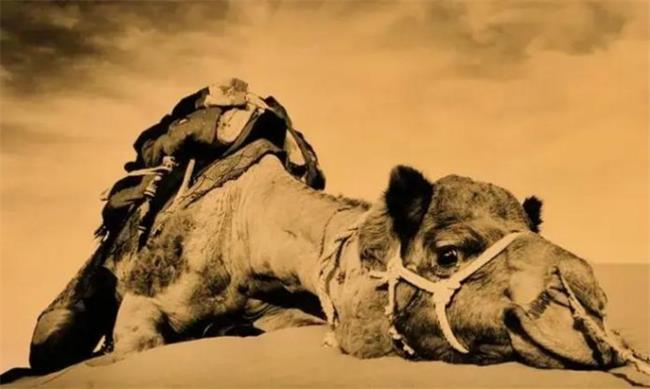
In the afternoon, the desert heat was scorching, with waves of heat radiating out, making our bodies ache all over. Just then, there was a thunderous crash. “Bogda,” who had carried the heaviest load all along and refused to drink, collapsed. A cloud of sand and dust billowed up, obscuring his body. Only after the dust settled did we see “Bogda,” foaming at the mouth, his limbs twitching, yet his eyes still open. The first to cry out was the company commander’s wife. Dragging her heavy frame, she slid recklessly off her camel’s back, unscrewed the military canteen, and said, “I have water. I won’t drink it—I’ll give it to you.” Yet “Bogda” kept its mouth tightly shut; no matter how hard the commander’s wife tried, it refused to open its mouth. Its gray-yellow eyes bore an expression of resolute acceptance of death.
Two soldiers also shed tears. They took off their jackets and held them over “Bogda’s” head to shield it from the sun and cool it down. The company commander’s wife aimed the canteen at “Bogda’s” nostrils and poured water in, but it was clearly too late. I stopped them. We stood in a line before “Bogda,” said our final goodbyes, and set off with tears in our eyes. “Bogda,” lying face-down in the shifting sands, raised his head and let out a muffled cry just after we had walked a few hundred meters away. Our hearts were weighed down to the very depths.
That night, we camped on an exposed riverbed; with “Bogda” gone, there was no way we could set up our earthen huts. The company commander’s wife refused to sleep as well. The four of us sat beside “Altay,” gazing up at the star-filled sky, speechless. We had two days left. Tomorrow, or perhaps the day after, though we wouldn’t have fully left the desert yet, we were certain to see vegetation and signs of life; if we were lucky, we might even find water. Yet, just as victory was within reach, “Bogda” had been left behind in the desert forever.
Dawn was breaking when an unusual sound startled us. “Altay” was the first to stand up. He turned around and let out a long, piercing cry in the direction we had come from. Looking in the direction of his cry, my mind went blank—there was “Bogda,” lying on his side, bathed in the morning light, staggering toward us. We cheered with excitement, rushing over recklessly to embrace “Bogda” from all sides, weeping softly. We were overjoyed at “Bogda’s” survival. But our assessment of what lay ahead had been far too optimistic. We failed to exit the desert by our estimated time. By noon the next day, we encountered the most terrifying black sandstorm. It was like countless black mosquitoes, swarming around you, biting you, lashing at you—capable of sucking every drop of moisture from your body.
After the black sandstorm, we were barely alive as we struggled to crawl out of the quicksand. Just then, “Bogda” let out a long, alarm-like howl and charged headfirst into a jagged black rock. His skull shattered, and bright red blood spurted out—a truly horrifying sight! “Bogda’s” blood filled a plastic bucket exactly to the brim—10 kilograms. It was thanks to those 10 kilograms of camel blood that we finally emerged from the desert three days later and entered Maigaiti. The company commander’s wife had been waiting in Maigaiti for a week. They dared not hope for the best and had quietly prepared a wreath. The company commander’s wife carried the wreath to the edge of the desert, facing the direction where “Bogda” had died, and lit two piles of joss paper. In her arms, she held the camel bell that had once hung around “Bogda’s” neck. Later, the company commander’s wife gave birth to a daughter, whom she named “Camel Bell.” She gave each of us a copy of the baby’s 100-day-old photo. In the picture, little Camel Bell is holding that same golden camel bell in her arms.