

The late-night subway glides like a weary silver fish through the city’s underground tunnels. The car is packed with people who have just finished their day’s work, and the air is a mixture of coffee, rain, and a faint sense of weariness. Eli leans against the cold glass door, clutching a black umbrella that hasn’t been opened yet.
As an archival conservator at the city library, Eli was used to dealing with old paper and dust. Today marked his seventh consecutive day of overtime, working to restore a nineteenth-century nautical logbook before the library closed. Even now, the rough texture of the paste still lingered on his fingertips, and his mind was filled with faded ink and broken binding threads.
The train emerged from underground and entered the elevated section spanning the river. The lights in the car dimmed for a split second, then brightened again. Eli instinctively looked up and saw thick rain clouds pressing down on the river outside the window, like a piece of gray cotton wool saturated with water, hanging heavily in the air.
There was no moon.
He recalled how, before he’d left, the landlady had been complaining at the door about this damned weather, saying there wasn’t even a bit of light, which made one feel uneasy. At the time, Eli had merely smiled and said nothing. He didn’t really care whether there was moonlight or not; after all, in the archives’ basement, time was measured by the brittleness of the paper, not by the phases of the moon.
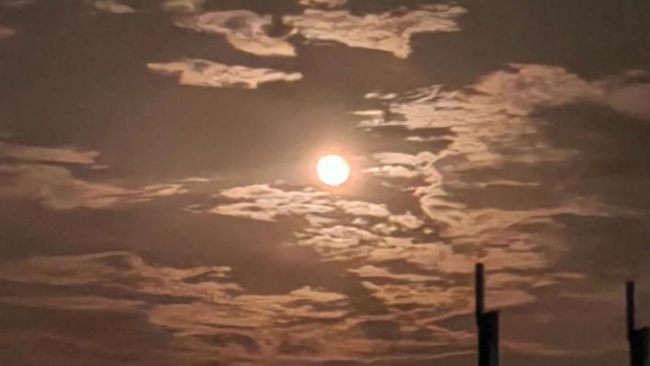
But just as the train rounded a curve, the clouds seemed to be torn open by the wind, revealing a very narrow slit.
There was no silver glow pouring down as he’d expected, only a wisp of extremely faint, soft light—like a sleeve accidentally peeking out from behind a heavy curtain, gently resting on the river’s surface. It wasn’t glaring; it wasn’t even particularly bright. Yet, amidst that murky gloom, it stubbornly cast a hint of warm white.
The light lingered on Eli’s retina for less than three seconds before being swallowed up by the clouds as they closed once more.
The train car remained quiet, broken only by the monotonous sound of the wheels grinding against the tracks. The young girl in the seat across from him was resting her eyes with headphones on; the screen of her phone was still lit, displaying an unsent draft. In the corner, a middle-aged man was carefully wiping a bouquet of slightly wilted delphiniums cradled in his arms.
Eli suddenly felt that the ray of light hadn’t disappeared.
It had merely hidden itself. Just like the resignation letter in his pocket—written, then deleted, then rewritten again; just like the unspoken “good night” on the girl’s phone; just like the bouquet in the middle-aged man’s arms, meant for his sick wife.
Most of the time, life is shrouded in clouds—gray and heavy. We’re all waiting for a magnificent moonrise, for a clear sign, for a promise that “everything will be all right.”
But perhaps the true light was never meant to illuminate the entire river.
It simply allowed you, in that one moment, to see clearly the umbrella clenched in your hand and the person still breathing beside you.
The train slowed gradually, and the station announcement sounded. Eli folded up his umbrella and followed the crowd toward the door. The rain was still falling outside, but he knew that above the clouds, the moon had never left.
He pushed open the door and stepped into the damp night, his footsteps a little lighter than when he’d arrived.