
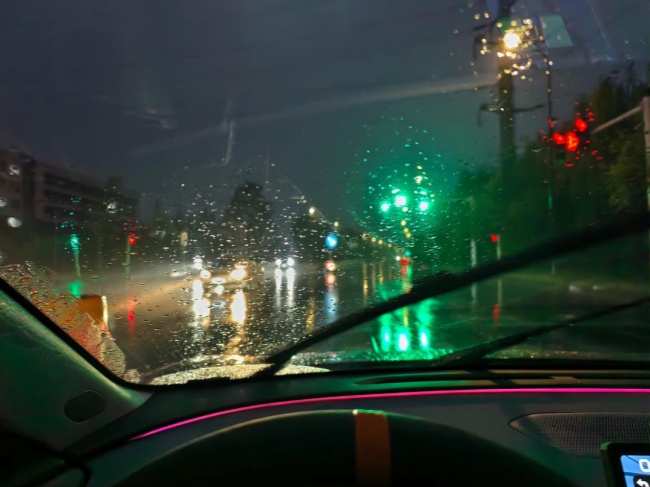

The rain wasn’t falling so much as it was being thrown against the windshield, horizontal sheets of gray that the wipers couldn’t quite keep up with. James gripped the steering wheel of his sedan, his knuckles white, staring at the glowing blue line on his phone screen.
“In two hundred feet, turn right,” the automated voice said. Calm. Unbothered. Completely detached from the fact that there was no road to the right, only a dense wall of pine trees and a muddy ditch.
“Right,” James muttered, his voice cracking from hours of silence. “Sure. Let’s just drive into the woods.”
He was three hours late for the reunion. Three hours late to explain himself to Sarah, to apologize for the job in Chicago, for the missed birthdays, for the ego that had convinced him he needed to be somewhere else to be someone. Now, the GPS was leading him in circles through the backroads of upstate New York, a labyrinth of county routes that all looked identical in the dark.
The signal bar on his phone flickered. One bar. Then none. Then one again.
“Recalculating,” the voice said. It sounded almost disappointed.
James sighed and turned the wheel, following the blue line as it curved sharply left onto a road that was barely more than gravel. The headlights cut through the fog, illuminating nothing but the endless, rhythmic trunks of trees. It felt less like a forest and more like the bars of a cage closing in.
He checked the time. 11:42 PM. The reunion had ended an hour ago. Sarah would be home by now, probably asleep, or maybe sitting on her porch waiting for a ghost that wasn’t going to show up.
The car hit a pothole, jarring his teeth. James slowed down to a crawl. The blue line on the screen was moving faster than he was, a digital promise of progress that reality wasn’t keeping. He felt that familiar tightness in his chest—the anxiety of being off-script. James was a man of itineraries, of five-year plans, of optimized routes. He didn’t do “lost.”
Suddenly, the trees broke.
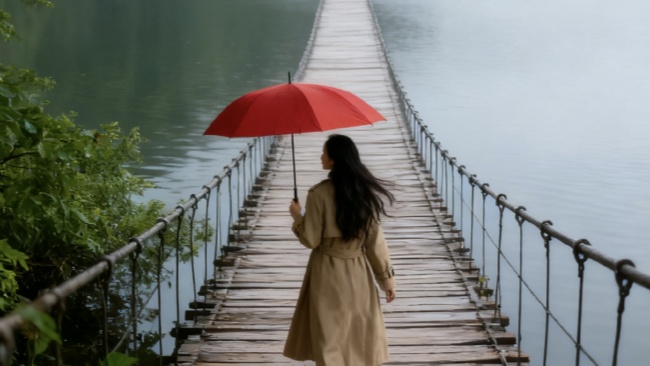
He wasn’t in the woods anymore. He was on a narrow bridge spanning a dark, swollen creek. The water rushed below, invisible but loud, roaring over rocks. In the middle of the bridge, the car sputtered. The engine gave a pathetic whine and died. The headlights flickered and faded, leaving him in absolute darkness.
“No,” James whispered. “No, no, no.”
He turned the key. Nothing. Just the sound of the rain and the rushing water.
He grabbed his phone. Dead battery. Of course.
James sat there for a long minute, listening to the storm. He was stranded, alone, in the middle of nowhere, on a night he was supposed to be fixing the biggest mistake of his life. The irony was heavy enough to crush the roof. He rested his forehead against the steering wheel and closed his eyes.
Then, he saw a light.
It wasn’t a car. It was a faint, yellow glow coming from a small structure on the other side of the bridge. A toll booth? No, it looked like a small cabin, or maybe an old gatehouse.
James opened the door. The cold hit him instantly, soaking his shirt. He slammed the door and ran across the bridge, the wind nearly knocking him over.
The door to the cabin was unlocked. He pushed it open, shivering violently.
Inside, it was warm. A wood stove crackled in the corner. An old man sat in a rocking chair, reading a paperback book. He didn’t look up. He just pointed to a dry towel hanging on a hook by the door.
“Phone charger’s on the counter,” the man said. His voice was like gravel, rough but steady. “Coffee’s fresh, if you want it.”
James grabbed the towel, drying his face. “My car died. On the bridge. I… I don’t know where I am.”
“You’re on the old mill road,” the man said, turning a page. “Cars die there sometimes. The damp gets into the electronics. Or maybe they just decide they don’t want to go any further.”
James plugged his phone in. It booted up. The GPS immediately pinged.
“You have arrived,” the voice announced cheerfully.
James stared at the screen. “This isn’t the destination. I was trying to get to Oakhaven. The community center.”
The old man finally looked up. His eyes were pale blue, surprisingly sharp. “Oakhaven is ten miles back the way you came. You passed the turnoff an hour ago.”
James felt a surge of frustration. “Then why did it bring me here?”
The man smiled, a small, crooked thing. “Maybe you weren’t supposed to go to Oakhaven tonight. Maybe you just needed to stop.”
James looked at the phone. The blue line had vanished, replaced by the spinning wheel of location searching. He looked at the old man, then at the fire. The warmth was seeping into his bones, loosening the knot in his chest.
He thought about Sarah. He thought about the speech he had rehearsed in the car, the defensive explanations, the need to be right. He realized he was exhausted. Not just from the driving, but from the running.
“I missed it,” James said softly. “I missed the chance.”
“Did you?” the man asked. He poured a mug of coffee and slid it across the table. “Or did you just miss the schedule?”
James took the mug. It was hot, bitter, and perfect. He sat down in the chair opposite the old man. Outside, the rain continued to hammer against the roof, but inside, it was quiet.
He didn’t call a tow truck. Not yet. He just sat there, drinking the coffee, watching the fire dance. For the first time in years, James wasn’t checking the time. He wasn’t worrying about the next step. He was just there.
The GPS on the counter buzzed. A notification.Route updated.
James looked at it, then reached over and turned the screen face down.
“Tell me about this road,” James said.
The old man leaned back, closing his book. “Well,” he began, “it’s a long story. Starts with a flood back in ’98…”
James listened. And for the first time in a long time, he didn’t mind being lost.