

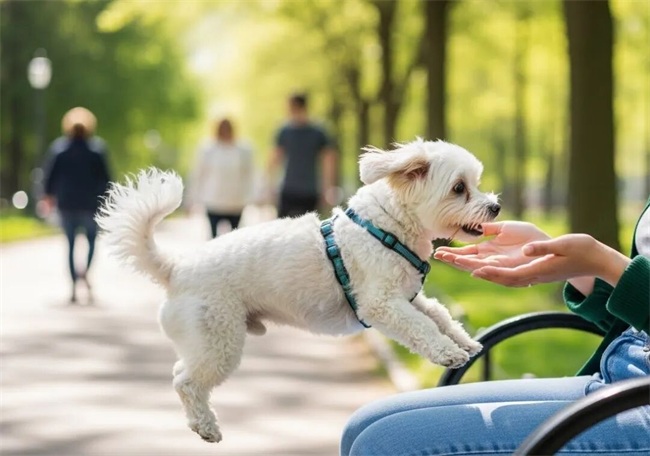

1. The “enthusiastic bomb” that made me both love and cringe
Last Saturday afternoon, I was standing at the gate of my neighborhood with my Golden Retriever, Nian Gao, waiting for a delivery. Nian Gao had just turned one, full of energy, and acted like everyone he met was a long-lost relative. From a distance, I saw my neighbor Aunt Zhang coming back from grocery shopping. His ears perked up, his tail spun like a propeller. Before I could tighten the leash, he had already shot off like a furry cannonball — both front paws landing squarely on Aunt Zhang’s shoulders, tongue lunging for her face. She stumbled back two steps, and tomatoes rolled all over the ground.
“It’s fine, it’s fine, dogs are just friendly,” Aunt Zhang said, waving her hand. But I clearly saw her instinctively lean backward. I apologized while pulling Nian Gao back, my face burning. This wasn’t the first time: delivery drivers, kids coming home from school, even food couriers passing by — they’d all received Nian Gao’s “flying-tackle greeting.” I knew he meant no harm, but others didn’t. What worried me more was: what if he knocked over an elderly person or a child?
(This story is a fictional case, used only for scenario illustration.)
2. Is jumping on people really just “being too friendly”?
Many dog owners see jumping as a sign of “enthusiasm” or “affection,” and even find it cute. But from a dog’s perspective, jumping is an innate social behavior. Puppies lick their mother’s mouth corners to beg for food, and adult dogs also use body-raising and paw-on-back gestures to express excitement or test boundaries. When a dog learns that jumping always gets attention — even if it’s being pushed away or scolded — it concludes that “this move works.”
The problem is, human social rules differ from dogs’. We like handshakes, smiles, and personal space, while a dog’s “greeting ritual” is leaning in, sniffing, and physical contact. Dogs jumping on people is usually not deliberate mischief — it’s that they want to interact so badly but haven’t learned a more appropriate way to express it. If the owner pets and laughs when the dog jumps, or just gently pushes it away, the dog interprets this as “you’re playing with me,” and the jumping behavior gets reinforced.
3. Understanding it is the first step to gently correcting it
To gently correct jumping, you need to understand a few key points:
First, jumping is a natural outlet for excitement. When a dog sees someone it likes or something new, adrenaline rises, and the body needs to release it. Jumping is one way to do that.
Second, dogs don’t understand “sometimes it’s okay to jump, sometimes it’s not.” If you let it jump on you when you come home but scold it for jumping on strangers outside, it gets confused. Rules must be consistent.
Third, punishment often backfires. Kicking, yelling, or holding the mouth shut may cause the dog to associate “strangers approaching” with “something scary,” potentially developing fear or aggression.
Fourth, a dog’s attention span is limited. Rather than stopping it after it jumps, guide it to do something else before it jumps.
4. 3 simple, actionable methods to gently correct jumping
1. Turn away and cold-shoulder + reward four paws on the ground
When your dog jumps on you or family members, immediately turn your back, cross your arms, and stay silent — no eye contact, no pushing. Wait until all four paws are on the ground and it’s calm, then turn around, crouch down to pet it, or give a treat. The key is: jumping = interaction stops; no jumping = attention received. Repeat a few times a day, and the dog quickly learns that “sitting or standing” pays off better than “jumping up.”
2. Intervene early and replace jumping with “sit”
Before your dog sees a familiar person, delivery driver, or is about to get excited, shorten the leash and guide it to sit. The moment its bottom touches the ground, immediately reward with a treat and a gentle voice. If it can’t hold the sit, step back a few paces, increase distance, and try again. The core of this method: let the dog associate “someone approaching” with “sit and wait,” not “rush up and jump.”
3. Ask a friend to help simulate real scenarios
Find a willing friend to ring the doorbell or walk toward you from a distance. If the dog jumps, the friend immediately turns and walks away; if the dog sits or keeps four paws on the ground, the friend approaches and gives a treat. Keep each session under 5 minutes, two or three times a day. Gradually increase distance and distractions until the dog stays calm in busier environments.
These methods require patience and consistency. Usually, you’ll see noticeable improvement within two to four weeks. If jumping is accompanied by growling, baring teeth, or a stiff body, stop training on your own and consult a professional pet behavior trainer or veterinarian.
Dogs jumping on people isn’t bad manners, and it’s not meant to embarrass you — they’re just using the wrong way to say hello. Through cold-shouldering, early guidance, and simulated training, you can gently teach your dog that sitting and waiting gets them the attention they want better than jumping up. Correcting jumping isn’t about suppressing their enthusiasm — it’s about helping them learn the social etiquette of the human world. After all, we want our dogs to be liked by more people, not avoided.
FAQ
When my dog jumps, I push it away or yell at it — why does it get worse?
Pushing and yelling may register as a “response” to your dog — it thinks you’re playing, or it associates “strangers approaching” with “being scolded,” creating fear. A more effective approach is to turn away and cold-shoulder, then reward when all four paws are on the ground, so it learns that jumping gets no attention and calm behavior pays off.
Can an adult dog still be corrected for jumping? How long does it take?
Yes, it can be corrected, but adult dogs have more ingrained habits and need more patience. Generally, with short daily training sessions, you’ll see improvement in two to four weeks. The key is that the whole family follows the same rules and uses treats to reward the right behavior instead of jumping. If jumping is accompanied by signs of aggression, consult a professional trainer as soon as possible.