
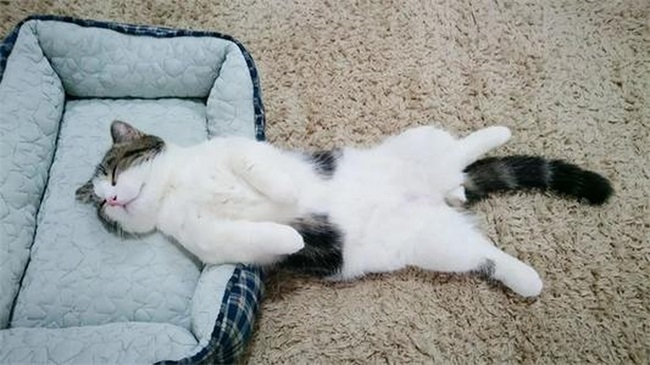

Sarah had just gotten back from the grocery store on a Saturday afternoon and set the bags down on the kitchen counter. Her orange tabby, Milo, ambled over, circled her ankles once, then flopped onto the floor without warning—all four paws in the air, belly exposed, rolling side to side. Sarah’s heart melted. She crouched down and reached out to touch. The next second, Milo’s paws clamped around her hand, his back legs kicked hard, and his teeth grazed the back of her hand. Sarah pulled back, looked at the red marks on her wrist, then at Milo, who was now innocently licking his paw. She was completely baffled: you showed me your belly, so why did you turn on me when I touched it?
(This story is a fictional case, used only for scenario illustration.)
Plenty of cat owners have fallen into this “belly trap.” When a dog rolls over and shows its belly, it’s usually asking for a rub—but cats are different. When a cat shows you its belly, it does have something to do with trust, but what it’s trying to say usually isn’t “come pet my belly.” In fact, for most cats the belly is the most sensitive, vulnerable part of the body. Exposing it is a signal of relaxation and trust—not an invitation to touch.
Behavior experts at the UK cat charity Cats Protection have pointed out that a cat showing its belly is a common trigger for misunderstandings. When a cat rolls over and exposes its abdomen in front of you, it’s saying: “I feel safe here—safe enough to show you my most vulnerable spot.” But that doesn’t mean it’s ready to have its belly touched. Just beneath a cat’s belly skin lie vital organs, and the hair follicles there are extremely sensitive. Being touched easily triggers a reflexive defensive response—grabbing your hand, kicking with the back legs, even a light bite. These are reflexes, not grudges, and not a sign that the cat has suddenly turned mean.
So why do some cats seem to enjoy belly rubs? A small number of cats do tolerate or even enjoy them, but that’s the exception, not the rule. More often, a cat flopping over may be stretching, cooling off, or simply finding the position comfortable. Sometimes it’s an invitation to play—a belly flop plus wriggling translates more like “chase me” or “bring a toy,” not “put your hand here.”
There are safer ways to respond to Milo’s trust than going for the belly. First, respond with your voice and your eyes. Crouch down, speak softly, or slow-blink at your cat. Cats read a slow blink positively, and it feels safer to them than a reaching hand. Second, pet the places it actually accepts. The chin, the sides of the cheeks, and the base of the ears are areas almost every cat welcomes. Sarah switched to scratching Milo’s chin, and he immediately tilted his head up and started purring—no kicking at all. Third, if you really want to test the belly, start with just one finger, touch the very edge of the belly lightly, then stop and watch. If the tail starts twitching, the ears flatten back, or the body tenses, that’s your cue to stop. If the cat stays soft and relaxed, you can try one more second next time. Hand the choice to the cat, and it’ll be more willing to cooperate.
So when a cat shows you its belly, it’s a quiet gift of trust, not a massage appointment. It’s showing you its most vulnerable spot, meaning “I feel safe with you nearby.” You can accept that gift with a chin scratch and a soft word—you don’t have to reach for the one place it doesn’t really want touched. Respect its small boundaries, and next time Milo flops over, Sarah will know exactly what to do: crouch down, smile, say “I see you,” and scratch behind his ears. That’s just right.
When my cat shows its belly, can I pet it there?
It’s best not to go straight for the belly. Most cats are very sensitive there, and reaching in can trigger a defensive reflex that leads to scratches or kicks. If you want to test it, start by petting the chin or cheeks and watch your cat’s reaction. Only a small number of cats tolerate belly rubs, and even then their tolerance can vary from day to day.
Besides trust, are there other reasons a cat shows its belly?
Yes. A cat may flop over to stretch and relax, to cool down, or to invite you to play. If its body is soft and its tail sways gently, it’s likely expressing relaxation or playfulness. But if the body is tense and the ears are flattened back, it may be a defensive posture—best to keep your distance then.