

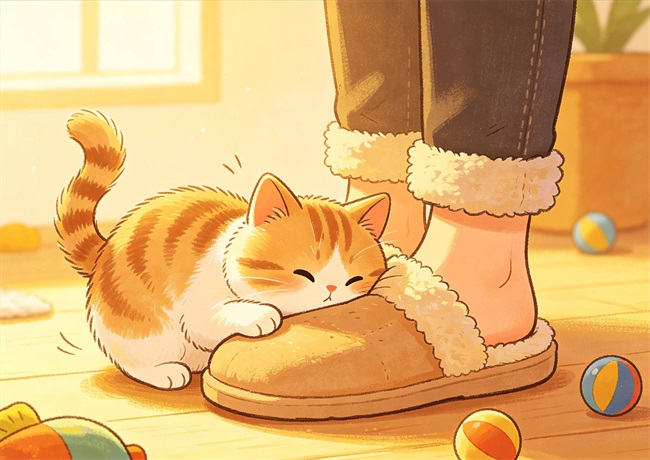

A Little Shadow Who Never Leaves Your Feet
Linran adopted a three-year-old tabby cat named Doudou. When she first brought him home, a friend warned her, “Tabbies are independent — not like Ragdolls who cling to you.” But the reality was the exact opposite — Doudou was like a walking magnet.
When Linran got up, Doudou followed her to the bathroom and perched on the washing machine, staring at her while she brushed her teeth. When she cooked, Doudou sat at the kitchen doorway, tail tapping the floor in rhythm. When she worked late into the night, Doudou lay beside the laptop, occasionally reaching out a paw to touch her wrist, as if to say, “Are you not done yet?” The most dramatic moment came when Linran went to the balcony to hang laundry — Doudou squeezed through the door too, even though the balcony was narrow and hot.
At first, Linran found it adorable. But gradually, she began to worry: Was Doudou too dependent on her? She tried closing the door, and Doudou would cry outside, clawing at the gap. After she came back from a two-day trip, Doudou’s voice was hoarse. Linran asked herself: Is my cat always following me out of love, or out of anxiety?
(This story is a fictional case, used only for scenario illustration.)
Following You Isn’t Always About Being “Clingy”
Many cat owners have similar experiences: wherever you go, your cat follows. Some people think the cat is “supervising” them, others think it’s “true love.” But more accurately, a cat following its owner is usually the result of multiple factors stacking together — habit, a sense of security, resource association, and sensitivity to environmental changes.
The question “why does my cat always follow me” rarely has a single answer. Some cats follow you because you equal “food and play.” Some follow you because when you leave, the environment feels unsafe. And some simply think wherever you’re sitting is the most comfortable spot. Understanding this is the key to judging: Is this healthy closeness, or dependence that needs adjustment?
Your Cat May Be Following You to Find “Stability”
Cats are territorial animals, but territory isn’t just space — it’s also familiar smells and rhythms. What time you get up, when you feed them, which chair you sit in — these patterns form your cat’s safety map. When you move, your cat follows you, essentially following its familiar “mobile safety zone.”
Cats also make direct associations with “resources.” You opening the fridge, grabbing a can, sitting on the couch — these actions may mean “something good is about to happen” in your cat’s eyes. It’s not scheming; it’s learning. Over time, following you becomes part of its daily route.
There’s another scenario: cats have different tolerances for “separation.” Some cats, after you close a door or leave the house, will meow, pace, or over-groom. This isn’t “holding a grudge” or “not being independent” — it’s stress from environmental change. If this stress persists long-term, it can develop into separation anxiety. But note: not every cat that follows its owner has anxiety. Many are just following habits and preferences.
Three Specific Things You Can Do
First, give your cat a space where it can feel safe without following you.
Near the room you spend the most time in, place a cat bed or cat tree, with a familiar blanket beside it. When you need to focus on work or rest, guide it there and give a small treat or toy. Let it know: not following you also leads to good things.
Second, turn “leaving” into a low-pressure mini-exercise.
If you notice your cat meowing after you close a door, don’t open it the moment it cries. Start with short intervals: leave the room for 30 seconds, come back, calmly give a treat. Gradually extend to a few minutes. The point is to let it experience “you leave and you come back” — not “you leave and disappear.”
Third, set a fixed interaction rhythm instead of responding at all hours.
Schedule two to three fixed play sessions per day, such as 10 minutes with a wand toy, followed by feeding. This way, your cat associates “interacting with the owner” with “predictable good things” rather than staring at you all day. If it rubs against you while you’re busy, redirect its attention with a toy or treat ball instead of immediately dropping everything.
If your cat shows persistent meowing, loss of appetite, over-grooming, or low energy, observe first and consult a professional veterinarian to rule out health issues. The above information is for daily reference only and cannot replace a professional veterinary diagnosis. If related symptoms persist, worsen, or are accompanied by abnormalities, please take your pet to a veterinarian promptly.
When a cat always follows its owner, it’s usually not “deliberately being clingy” — it’s the cat’s way of confirming that the environment is stable, resources are reliable, and you’re still there. Understanding this means you don’t need to push it away in a hurry, nor worry excessively. By adjusting the environment, practicing brief departures, and setting a fixed interaction rhythm, you can help it build a calmer sense of security and make your relationship more relaxed. After all, it follows you not to control you, but to stay in the same safe world as you.
FAQ
Does my cat always following me mean it has separation anxiety?
Not necessarily. Many cats follow their owners simply out of habit or a desire to be involved in what you’re doing. But if it persistently meows after you leave, stops eating, or over-grooms, that could be a sign of separation anxiety. You can start with short departure exercises, and consult a veterinarian or pet behavior specialist if needed.
Is it normal for my cat to follow me to the bathroom or shower?
Very common. Cats are sensitive to water and enclosed spaces. When you close the door, it may worry that “you’re trapped” or is simply curious. As long as it isn’t anxious to the point of crying or clawing at the door, there’s no need to worry. You can leave the door slightly ajar, or place a favorite mat by the bathroom entrance so it can wait comfortably.