
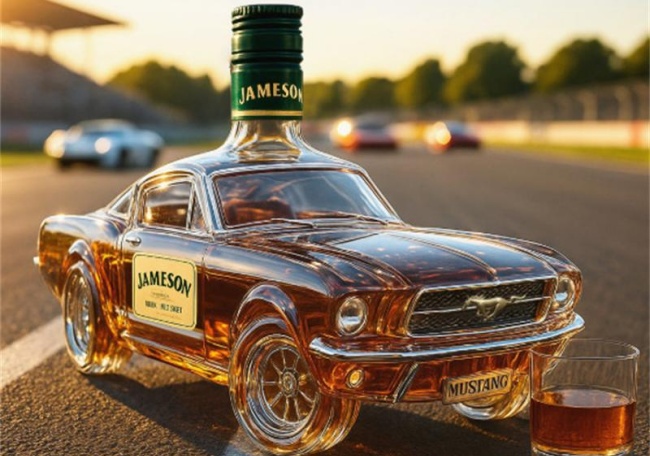

When Mark placed the Mustang-shaped whiskey bottle on his desk, the entire department fell silent for a second.
It was an exquisite glass ornament, its body amber-colored like a frozen sunset, with the word “MUSTANG” engraved on the hood. A “JAMESON” label was affixed to the side of the bottle, and the deep green cap created a strange harmony with the warm tones of the car’s body. It didn’t look like a liquor bottle so much as a work of art—a memento of the racetrack, of freedom, and of some distant summer.
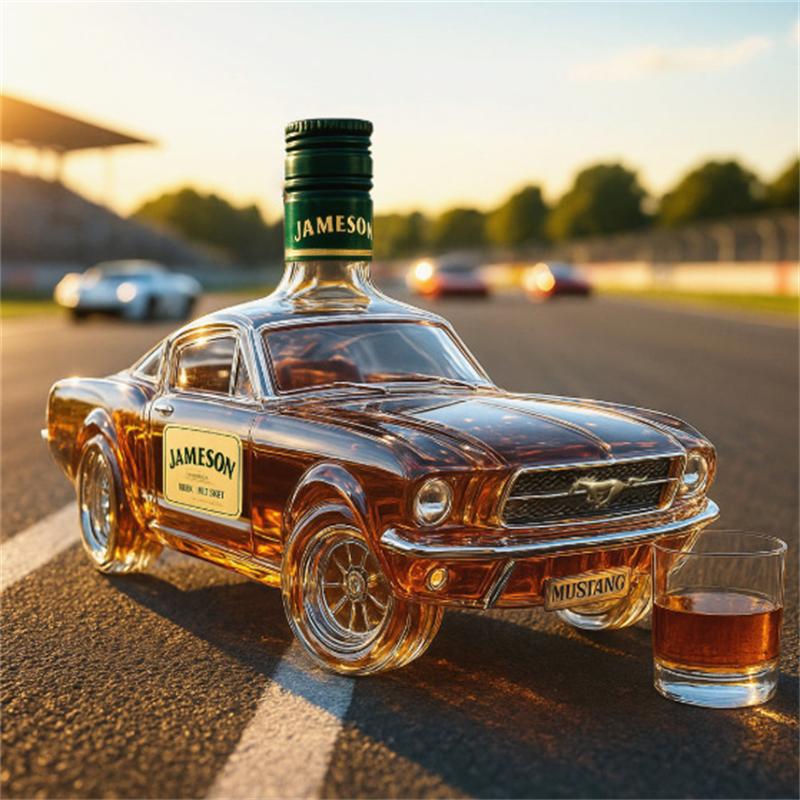
Mark isn’t the type to buy something like this. He’s a data analyst whose life is carved into precise fragments by Excel spreadsheets and KPIs. He stumbled upon this bottle last week at an antique shop; the owner said it came from an old race car driver’s collection. Mark bought it on a whim—perhaps because his boss had just rejected his third proposal that day, or perhaps because he needed something “imprecise” to counter the suffocating feeling of his life.
He placed the bottle next to his keyboard, typing code and generating reports while looking at it every day. His colleagues would occasionally cast curious glances its way, but no one dared to ask. Mark himself couldn’t explain why he kept it. He just felt that whenever his eyes swept over the sleek lines of the car’s body, a tight knot in his heart would loosen just a little.
Until that night when he worked overtime until the early hours of the morning.
He was the only one left in the office, and the hum of the air conditioner sounded like a whisper. Staring at the dense array of data on the screen, he felt as if his soul were being drained bit by bit. He instinctively reached for his cup but knocked over the Mustang liquor bottle instead.
The bottle didn’t shatter. It simply rolled gently to the corner of the desk, where it came to rest, its “headlights” shining toward the pitch-black night sky outside the window.
Mark froze. He suddenly realized that this bottle had never been empty.
He’d always assumed it contained whiskey, or at least some kind of liquid. But now, in the dim yellow glow of the desk lamp, he saw clearly—what the bottle held was light.
Not reflected light, but a warm, flowing amber glow emanating from within. It was like a liquid twilight, like the last ray of sunset sealed within a racetrack. It rested quietly within the glass body—unobtrusive, unassuming—yet more real and powerful than any data.
Mark reached out, his fingertips touching the cool glass. In that moment, it was as if he understood something.
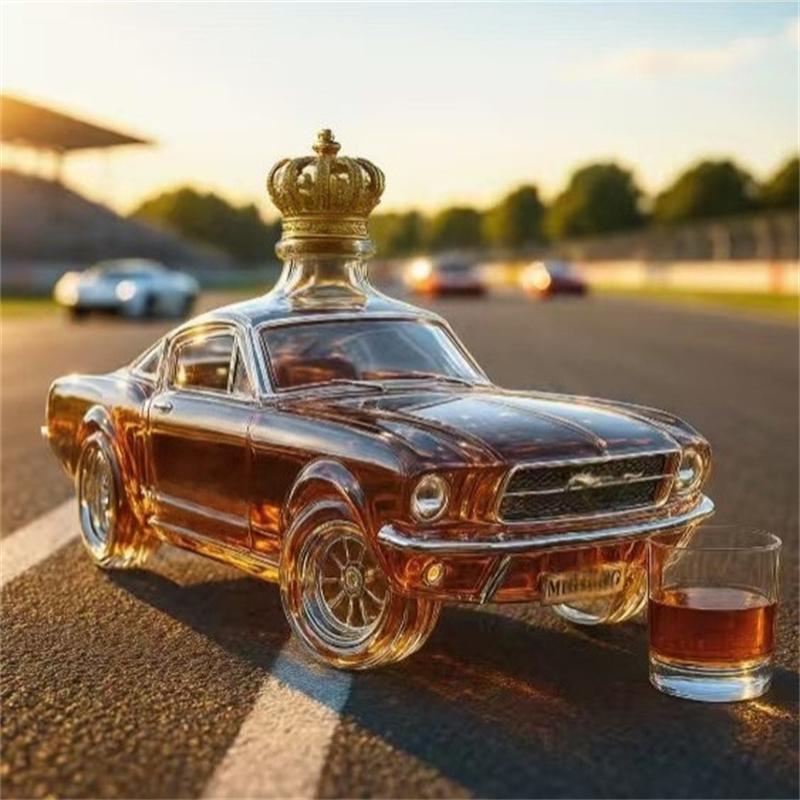
He had always been chasing the things he could see: promotions, pay raises, and the approval of others. He had turned his life into a series of precise calculations, believing that as long as he got every step right, he would reach the finish line. But he had forgotten that some things simply cannot be calculated. Like the light inside this bottle, like the flutter in his heart the moment he bought it, like this very moment—sitting alone in the empty office, yet feeling for the first time that he hadn’t been completely swallowed up.
He didn’t open the cap. He knew that once he did, the light would fade away.
He simply gazed at it quietly, watching that tiny, silent Mustang, carrying the light of an entire summer, parked right in the center of his chaotic life.
The next day, Mark put the bottle away in his drawer. He didn’t quit his job, nor did he suddenly become carefree. He still had to face reports, meetings, and his boss’s frowns. But something had changed.
He began allowing himself to daydream for five minutes during his lunch break, allowing himself to include a bit of “impractical” creativity in his proposals, and allowing himself to take a detour home after work just to catch a glimpse of the sunset on the horizon.
He no longer tried to fill every moment, nor did he fear the void. Because he knew that some light can only be seen when you stand still.
That Wild Horse wine bottle still lay deep in the drawer, its light never extinguished. It was no longer just a decoration, but a reminder: in a world that chases speed, true strength may come precisely from knowing when to stop—to let the light shine in.