

James found the umbrella on a Tuesday, leaning against the glass door of a coffee shop on 4th and Main. It was navy blue, with a curved wooden handle and a small brass tag that readM. Whitfield in faded ink.
He almost walked past it. But something about the way it stood there—upright, patient, like it was waiting for someone—made him stop.
Outside, the sky was clear. Not a cloud in sight.
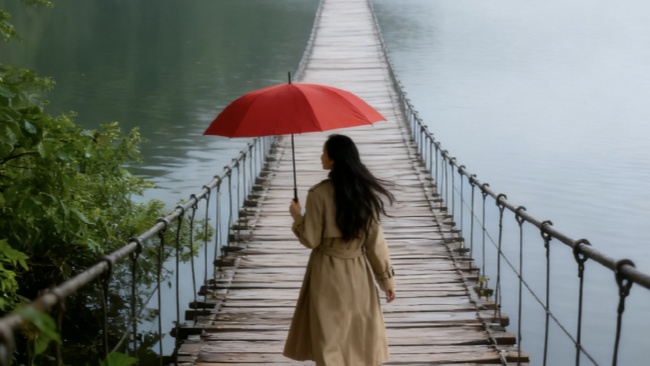
He picked it up, turned it over in his hands, and pushed the button. The canopy snapped open with a satisfying click, stretching wide above his head like a small, dark sky.
No rain came.
James looked around. A few people glanced his way, but no one said anything. He folded it back up, tucked it under his arm, and went inside to order his usual black coffee.
That was three weeks ago.
Since then, James had carried the umbrella everywhere. To work. To the grocery store. To the park on Sunday mornings when he sat on a bench and watched his daughter, Emma, chase pigeons across the grass.
He never opened it again. Not once.
But he carried it.
His coworkers noticed first. “Expecting a storm?” his desk neighbor, Rachel, asked one morning, nodding at the umbrella leaning against his filing cabinet.
“Maybe,” James said, though he didn’t know why he said it.
The truth was, he’d been carrying it since the day his wife, Margaret, moved out. Six months now. The apartment felt too quiet without her—the kind of quiet that pressed against your ears and made you aware of every small sound: the fridge humming, the faucet dripping, the clock ticking past midnight.
The umbrella didn’t fix any of that. But holding it—feeling the weight of it in his hand—gave him something to do with his hands. Something to hold onto.
One Saturday in late October, James took Emma to the farmer’s market. She was seven, missing her two front teeth, and had recently decided that everything in the world was either “cool” or “boring.” The farmer’s market, she announced within thirty seconds of arriving, was “kind of boring.”
James smiled. “Give it a chance.”
They wandered past tables of honey jars and hand-poured candles. Emma stopped to stare at a woman braiding wool into thick, colorful ropes. James bought a bag of apples and a loaf of bread that smelled like home.
Then the sky changed.
It happened fast—one minute the sun was warm on his neck, and the next, a cold wind swept through the market, rattling the canvas tents. The clouds rolled in like a dark curtain, and within minutes, rain began to fall. Not a drizzle. A downpour.
People scattered. Vendors scrambled to cover their goods. Emma grabbed James’s hand and looked up at him with wide eyes.
James looked down at the umbrella in his other hand.
He pressed the button. The navy canopy opened with that same sharp click, and he held it over both of them.
The rain hammered against the fabric above their heads. Emma pressed close to his side, and for a moment, the world shrank to just the two of them standing under that small dark roof while everything around them turned to water and noise.
“Dad?” Emma said.
“Yeah, bug?”
“Whose umbrella is this?”
James looked at the brass tag.M. Whitfield. He’d thought about it before—wondered who Margaret Whitfield was, or if it was a Michael, or a Martin. Someone who’d left this umbrella behind in a coffee shop and never came back for it.
“I don’t know,” he said. “Someone’s, I guess.”
Emma was quiet for a moment, watching the rain slide off the edge of the canopy in little silver threads.
“Do you think they’re okay?” she asked.
James felt something tighten in his chest. Not pain, exactly. Something softer. Something like the moment right before you realize you’ve been holding your breath.
“Yeah,” he said. “I think so.”
They stood there a while longer, waiting for the rain to ease. When it finally did, James folded the umbrella and tucked it under his arm.
On the walk home, Emma skipped ahead of him, splashing through puddles in her light-up sneakers. James watched her go, the umbrella swinging gently at his side.
He thought about leaving it on a bench somewhere. Letting someone else find it. Letting it go.
But he didn’t.
Not yet.
Some things we carry not because they protect us from anything, but because letting go feels like admitting we needed them in the first place. And maybe that’s alright—for now.