
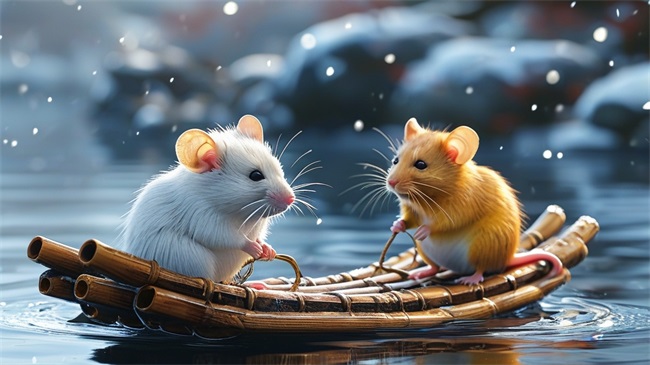

Under the roots of an old oak tree lived a little mouse named Barnaby. Unlike other mice, who loved nothing more than gnawing on cheese and hoarding nuts, Barnaby had a special hobby—watching humans play chess.
Every evening, when the setting sun bathed the park benches in a honey-colored glow, Barnaby would peek his fuzzy little head out from between the tree roots, prick up his ears, and wait quietly. His seat was a warm cobblestone beneath the bench—a spot with a perfect view where he wouldn’t be spotted.
That evening, two regulars were seated on the bench: white-haired Grandpa Henry and Tom, the young neighbor who was always frowning. On the chessboard, black and white pieces stood in silent confrontation; the air was filled only with the soft clatter of pieces landing on the wood and the faint, distant sounds of children playing.
“Check,” Grandpa Henry’s voice was as soft as old velvet.
Tom sighed, his finger hovering over the board, hesitating to make his move. Barnaby shifted slightly on the cobblestones, his little paws clenched nervously. He understood the move—Grandpa Henry’s knight was quietly circling around behind the king, as light as a falling leaf, yet with undeniable power.
“Grandpa, am I just too slow?” Tom finally spoke, his voice tinged with the impatience typical of youth. “I’ve been learning for three months, and I still can’t beat you.”
Grandpa Henry didn’t answer right away. He lifted his warm teacup, his gaze drifting past the chessboard to the leaves rustling in the evening breeze in the distance. “Tom,” he said softly, “look at that tree. How many years did it take for it to learn to stand firm in the wind? Playing chess isn’t a contest to see who’s smarter—it’s about learning to be friends with time.”
Barnaby held his breath. He remembered the first time he’d tried to climb over the garden fence; he’d fallen a full seven times. On the eighth try, he’d finally found that loose plank. It turned out even a mouse understood the principle of “being friends with time.”
Tom fell silent. He no longer rushed to move his pieces; instead, following Grandpa Henry’s example, he lifted his teacup and took a deep breath. The scent of tea mingled with the fragrance of fresh grass drifted into Barnaby’s nose, and he couldn’t help but let out a tiny sneeze.
“Achoo!”
The sound was as soft as a feather landing, but both Grandpa Henry and Tom heard it. They both looked down and saw the little gray-brown mouse on the cobblestone, covering its nose with its paws, its round, black eyes gazing at them innocently.
Tom froze for a moment, then a gentle smile curved his lips. “Grandpa,” he whispered, “it looks like we have a new spectator.”
Grandpa Henry smiled, the wrinkles at the corners of his eyes blooming like chrysanthemums. “Then let him keep watching,” he said, gently pushing a white pawn to the center of the board. “I’ve been thinking about this move for a long time. It’s taught me that sometimes the bravest thing isn’t to attack, but to wait patiently.”
Barnaby didn’t run away. He crouched on the cobblestones, watching the tiny white pawn stand steadily in the center of the board, like a quiet star. The evening breeze blew by, carrying the sweet scent of the bakery in the distance. The two men on the bench said nothing more; they simply sat in silence, the chess pieces glowing softly in the twilight.
That evening, when Barnaby returned to his home beneath the tree roots, he had a piece of mint candy in his mouth—one someone had left behind. The wrapper shimmered faintly in the moonlight, like a tiny star that would never melt. Curled up on his bed of hay, listening to the faint chirping of insects in the distance, he thought of that quiet white pawn on the chessboard, of Grandpa Henry’s gentle voice, and of the smile playing at the corner of Tom’s mouth.
It turned out that some victories aren’t about winning a game, but about learning, through waiting, to savor the sweetness of life itself.
Barnaby closed his eyes as the coolness of the mint slowly melted on his tongue. Before drifting off to sleep, he whispered to himself, “Good night, chessboard. Good night, time. Good night, all the little lives that have learned to wait.”
Moonlight streamed through the gaps between the tree roots, illuminating the smile that still lingered at the corner of his mouth. In the gentle embrace of the old oak tree, a little mouse, his heart filled with warmth, slipped into a dream sweeter than honey.