
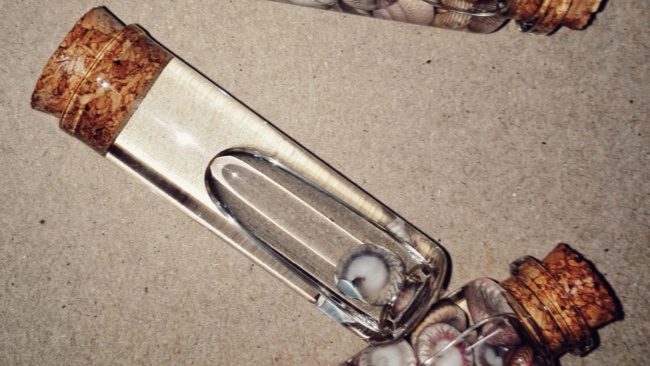

Alex found it on a rainy night. It was a glass bottle, about the size of his palm, sealed with a cork and half-filled with a gray-blue powder as fine as sand. Engraved on the bottle was a line of small text: “Pour in your regrets, and you will find peace.”
He smiled and slipped the bottle into the pocket of his trench coat. Thirty-four years old, a mid-level executive at an advertising agency, he’d just been berated by a client for twenty minutes over the phone about a proposal he’d opposed from the start. Back at his apartment, he stared at the bottle, and on a whim, unscrewed the cork and said into the opening, “I regret taking that call today.”
The gray-blue powder trembled slightly, rising and swirling as if alive, then settling back down. Alex felt the lump of frustration that had been weighing on his chest for two days dissipate just a little. Just a little, really—like a fine crack appearing on the surface of ice.
From that day on, the bottle became his confidant. He regretted not standing his ground at the meeting; he regretted turning down another company three years ago; he regretted losing his temper with an intern last month; he regretted choosing advertising over architecture in college. Each time he spoke, the powder would swirl slightly, and a corner of his heart would feel a little lighter. The powder in the bottle was slowly increasing, from half a bottle to three-quarters full.
The bottle’s presence grew stronger and stronger. Alex began carrying it with him everywhere—on the subway, in meeting rooms, and in the kitchen late at night. He found himself relying more and more on that feeling of “being accepted.” Pouring out his regrets made him feel whole again.
Until last night, when he unscrewed the wooden stopper and said, “I regret not saying a proper goodbye when we broke up.”
The powder churned violently, its color shifting from gray-blue to deep purple. A face flashed before Alex’s eyes—Martha, the woman who’d left him three years ago. The next second, his phone rang. It was Martha.
“Alex?” The voice was distant yet clear. “I had a dream—you kept saying you were sorry…”
They talked for four hours. When he hung up, the sky outside the window was already turning pale. Alex looked down at the bottle; the powder had settled, but the first crack had appeared, winding from the neck to the bottom.
That morning, he took the bottle to work. When the director announced that they would submit that ridiculous proposal to the client, Alex stood up and heard himself say, “I disagree.” The conference room was so quiet you could hear the hum of the air conditioner. He presented his case, refuted the arguments, and proposed a new plan. The director’s expression changed three times before he finally said, “Rewrite it.”
It was raining as he left work, just like the day he found the bottle. Alex placed the bottle on the windowsill and unscrewed the cork.
“I regret… not learning to say ‘no’ sooner,” he whispered.
The bottle showed no reaction. The powder lay motionless, gray-blue, like a dead sea. Alex waited a moment, then tried again: “I regret always pouring my feelings into this bottle.”
Still no reaction. The sound of rain filled the silence.
Alex held the bottle up to his eyes. Through the glass, he saw his own palm, with its distinct knuckles, trembling slightly. The powder reflected not regret, but the very words “I regret” that he had spoken each time—they no longer belonged to him; they had long since become the contents of the bottle,陌生, quiet, and unrelated to him.
He suddenly realized that every regret he’d remembered over the past three months had only truly been acknowledged after he’d spoken the words. Before he spoke, they were merely chaotic, swirling shadows. It was he himself who, time and again, chose to name those shadows “regret” and then hand them over.
Another crack appeared in the bottle. It was very fine, visible only when held up to the light.
Alex set the bottle back on the windowsill without screwing the wooden stopper back on tightly. The rain had stopped, and the city lights shattered into a patchwork of light on the wet glass. He didn’t know if he’d ever speak to the bottle again. But he found that when he stopped trying to “pour anything out,” his heart was filled with a sense of completeness and weight he’d never felt before.
That weight wasn’t light, nor was it heavy. It was simply there. Just like on that rainy night when he first saw the bottle, back when he’d thought he’d found nothing more than a container.
He felt the pocket of his trench coat—it was empty. Then he turned and walked toward the kitchen to make himself a cup of coffee.