
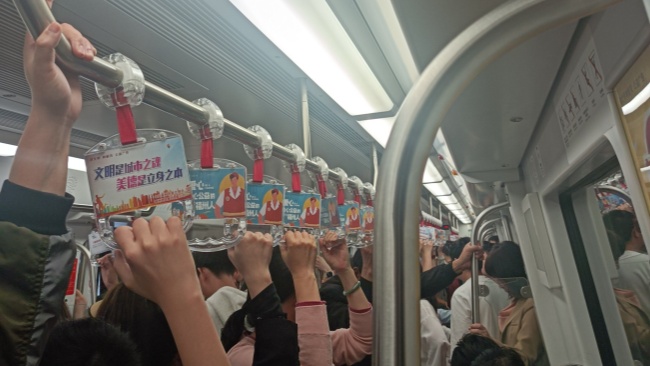

The 7:42 train into the city smelled like wet wool, burnt coffee, and the particular silence of people who had agreed, without speaking, not to notice each other.
James stood near the doors with his bag pressed against his chest. He had taken the same car, the same spot, every weekday for three years. He knew the rhythm of it: the rush at 7:38, the sigh when the doors closed, the woman in the green scarf who always answered her phone too loudly, the businessman who slept with his mouth slightly open, the teenager with headphones who never looked up.
He knew the faces, but he did not know the names.
That morning, the train stopped between stations.
At first, no one reacted. A few people glanced at their watches. Someone muttered, “Of course.” The lights flickered once, then stayed on. The air grew warmer.
James looked down at his phone. No signal. He looked up at the ceiling, then at the crowd, then at nothing in particular.
That was when he saw the hand.
It was resting on the metal pole beside him—pale, thin, with a small silver ring on the fourth finger. The sleeve above it was dark blue, slightly frayed at the cuff. James had not noticed it before. He was sure of that.
He looked around for the person it belonged to.
A woman in a gray coat stood nearby, but her hands were both inside her pockets. A man in a suit had one hand on his briefcase and the other holding the overhead rail. The teenager with the headphones had both hands buried in a backpack.
James looked back at the pole.
The hand was still there.
It did not move. It did not grip the pole like someone holding on during a delay. It simply rested there, fingers slightly curled, as if it had been placed carefully and forgotten.
James told himself he was tired. He had slept badly. His daughter had been sick the night before, and his mind had been somewhere else since six in the morning. He blinked hard and looked again.
The hand was gone.
He let out a breath he did not realize he had been holding.
Then the train jolted forward.
People swayed. The woman in the green scarf grabbed the seat back. The businessman opened his eyes with a start. James caught himself on the pole—and felt it.
Cold.
Not the ordinary cold of metal in an air-conditioned car. This was the kind of cold that made him pull his hand away too fast, like touching a window in winter and finding it already open.
He stared at the pole.
There was nothing there.
“Everything okay?” the businessman asked.
James looked at him. The man’s face was ordinary: tired eyes, a coffee stain on his tie, a name badge that read R. HARRIS.
“Fine,” James said. “Just… did you see a hand on this pole a second ago?”
The man frowned. “A hand?”
James felt foolish immediately. “Never mind.”
The businessman gave him a short nod and turned away.
But James could not stop looking.
The train slowed again. Not a full stop this time—just a long, uneven crawl. The lights dimmed, then brightened. Somewhere ahead, a door opened and closed with a hollow sound.
James thought about his daughter. She was seven. She had pressed her forehead to his shoulder before he left that morning and said, “Don’t forget to come back the same way.”
He had laughed and said, “That’s the only way I know.”
Now the words came back to him strangely, as if the train had heard them and decided to test him.
The woman in the green scarf stepped closer to the doors. The teenager shifted his weight. The businessman closed his eyes again. Everyone returned to their private weather.
James looked at the pole one more time.
The hand was there.
This time, he did not look away.
It was smaller than he remembered, or maybe he was simply paying better attention. The silver ring caught the light. The fingers were relaxed, almost gentle.
And then he noticed something else.
The sleeve.
It was not dark blue. It was the color of his daughter’s winter coat—the one she had outgrown last month and that his wife had donated to a shelter on Maple Street.
James felt the air leave his lungs.
He had seen that coat every morning for two years. He had zipped it himself a hundred times. He had laughed when she said the sleeves made her look like a penguin. He had kissed the top of her head when she wore the hood up.
The hand did not belong to his daughter. He knew that. His daughter was at home, safe in bed, probably dreaming about pancakes.
But the sleeve did.
The train gave a final shudder and moved smoothly into the station. The doors opened. Morning light poured in, ordinary and gray.
People stepped out. People stepped in. The woman in the green scarf answered another call. The businessman adjusted his briefcase. The teenager disappeared into the crowd without looking back.
James stayed where he was for one second longer.
The hand was gone.
The pole was just a pole.
He stepped onto the platform and walked toward the exit without running, though every part of him wanted to. Outside, the city was loud and indifferent. A bus hissed past. A man on a bicycle rang his bell. Somewhere, someone was laughing.
James took out his phone and called home.
His wife answered on the second ring.
“She’s still asleep,” she said. “Why? Is everything okay?”
James looked back at the station entrance. The morning commuters moved around him like water around a stone.
“Yeah,” he said. “Everything’s fine.”
He paused.
“I just wanted to hear your voices.”
On the other end of the line, there was a soft rustle, then a small sleepy voice.
“Daddy?”
James closed his eyes.
“I’m here,” he said.
And for the first time that morning, he believed it.