

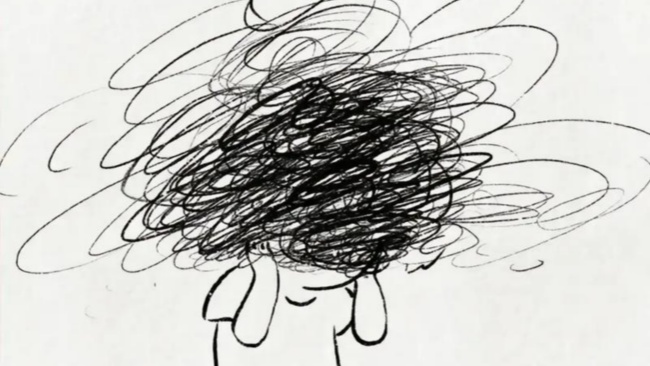

Once again, an email popped up. Amy saw the familiar profile picture and let her fingertips hover over the trackpad for two seconds.
“Hi Amy, the last draft was mostly OK, but there are a few small things I’d like to tweak—you know, just tweak it a bit; it won’t be much trouble.”
She stared at those four words—“just tweak it a bit”—for three seconds. The previous email had those same four words. So did the one before that. This was already the eighth time she’d been told to “just tweak it a bit.”
Outside the window was the perpetually gray sky of Midtown Manhattan. It was 7:40 p.m., and only a single desk lamp remained lit at her workstation. James from the neighboring team had left long ago; the succulent on his desk hung limply, a perfect reflection of her current state of mind.
She opened the file and went through the client’s revision notes one by one. They claimed it was “just a few minor changes,” but the list actually contained seventeen items. Item three: Make the blue in the homepage banner a bit cooler, but not too much—it should be “just barely noticeable.” Item five: Bold the title font by 2 percent—yes, exactly 2 percent, not a bit more. Item twelve: The white space on the entire page “feels” half a centimeter too wide; they’d like it “visually” tightened up a bit.
Amy picked up her mug; the coffee had gone completely cold. She recalled five years ago, when she was just starting out in the industry and received her first “just tweak it a bit” request. She had stayed up all night creating three versions for the client to choose from. Now she understood—so-called “just a little tweak” was never really just a little. It was a figure of speech clients used to ease their own guilt, as if to say, “I’m only bothering you a tiny bit.”
She got to work. While adjusting the blue, she changed the color value from #4A7CF5 to #4A7CF7, then to #4A7CF6. Finally, she settled on #4A7CF6 and wrote a note to herself: “A difference of two units that the client won’t notice, but I’m done.”
To bold the font by 2%, she tested it three times in Keynote and discovered that, to the naked eye, there was actually no difference between 1.8% and 2%. She chose 2% because, at least, the number looked neat.
When she reached the twelfth adjustment, she paused. She scaled the page down to actual size and stared for a long time at that so-called “half-centimeter of extra white space.” She turned off the guides and rulers, relying solely on her eyes—and shifted it up by two pixels.
Save. File name: project_final_v8_FINAL.ai.
She thought for a moment, then made a copy and renamed it: project_final_v8_FINAL_really.ai.
The moment she closed her laptop, her phone lit up. It was a message from the client: “Great work, Amy! I’ll take another look tomorrow—go home for now.”
She didn’t reply. She slung her bag over her shoulder and stepped into the elevator. Outside the glass curtain wall, the city’s lights were coming on one by one. She suddenly recalled her mother asking over the phone last week, “You’re constantly making changes every day—what exactly are you doing?”
She hadn’t been able to answer then.
Now, as she stepped out of the office building and the slightly chilly October breeze swept up her collar, she thought: I suppose it’s about helping the world’s shades of blue find that one shade that’s just right.
Although no one can really tell what that “just right” looks like.
But she knew it was there. And that was probably enough.