

Every morning at exactly 8:55, Lynn steps into the elevator of her office building.
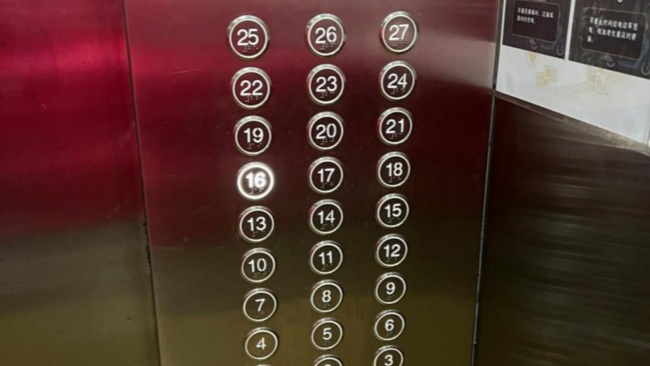
The office building has 28 floors, and her advertising agency is on the 23rd floor. The elevator buttons, numbered from B1 to 28, are neatly arranged with clear, legible numbers. Every day, she presses 23, watches the floor number change, and listens to the faint mechanical hum until the doors open and she steps into her familiar office area.
Until that Monday.
That day, she stepped into the elevator, looked down at her phone, and pressed a button without thinking—only to hit 24.
“Oh no,” she thought. The 24th floor housed another company; she didn’t know anyone there.
As the elevator rose slowly, she was about to get off on the 24th floor and wait for the next one when she suddenly noticed something: between 23 and 24 on the button panel, there was an extra button.
It had no number, just an extremely thin horizontal line, as if it had been deliberately erased.
Lin En froze.
She remembered clearly that last week, that spot had been blank. She even lightly touched the button with her finger—it was slightly raised and felt cool to the touch, like metal, or perhaps some unknown material.
She didn’t press it.
The elevator reached the 23rd floor. She stepped out and glanced back—the button panel had returned to normal; the horizontal line was gone.
“I must have seen it wrong,” she told herself.
But the next day, she saw it again.
On the third and fourth days, the button remained there, like a silent invitation.
She began to observe her colleagues. No one had ever mentioned that button. She even asked her colleagues point-blank in the elevator, “Don’t you think this elevator button is a little strange?” Her colleagues shook their heads: “No, it’s perfectly normal.”
Only she could see it.
On the fifth day, she finally reached out and pressed it.
There was no sound, no vibration. The elevator didn’t move.
But the doors opened.
Beyond the doors was neither the office nor the hallway.
It was a quiet rooftop garden. Sunlight slanted in, a gentle breeze rustled through the greenery, and the city skyline stretched out in the distance. On a wooden chair sat a cup of coffee, still steaming.
Lin En stepped out.
She didn’t know where she was, nor could she remember how she’d gotten there by elevator. She sat down on the chair and took a sip of coffee—it was her favorite caramel latte, at just the right temperature.
She sat there for ten minutes, then walked back to the elevator and pressed 23.
The doors opened, and she returned to her office as if nothing had happened.
But from that day on, she would press that unnumbered button in the elevator every day.
Sometimes it was early in the morning; sometimes late at night after working overtime. The elevator would always take her to that rooftop garden. Sometimes there was coffee, sometimes a book, and sometimes just the quiet breeze.
She began to look forward to going to work—not because of the job itself, but because of those ten minutes on the “extra floor.”
Until one day, after she pressed the button and the doors opened, she saw a woman sitting in the garden.
The woman turned her head and smiled at her.
Lin En recognized her—it was herself from five years ago.
Thinner, more exhausted, her eyes still reflecting the anxiety of a newcomer to the workforce.
“You’re finally here,” that “her” said. “I’ve been waiting for you here for a long time.”
Lin En stood at the doorway, saying nothing.
“You press 23 every day, thinking that’s your destination,” her past self said softly. “But what you really need has never been the 23rd floor.”
Lin En looked down at her hands and suddenly realized—it had been a long time since she’d asked herself: Where do I really want to go?
She walked into the garden and sat down on that wooden chair. The breeze was still gentle, and the coffee was still warm.
The elevator doors closed slowly, without a sound.
The next morning, Lin En stepped into the elevator.
She looked at the button panel; the horizontal line was still there.
But she didn’t press it.
She pressed 23, and then, just as the doors were about to close, she gently pressed B1.
The elevator descended.
She stepped out of the building, sunlight streaming onto her face.
For the first time, she felt that the 23rd floor wasn’t really that important after all.
And that extra floor—perhaps it was never meant for her to stay.
Rather, it was meant to make her finally willing to leave.