
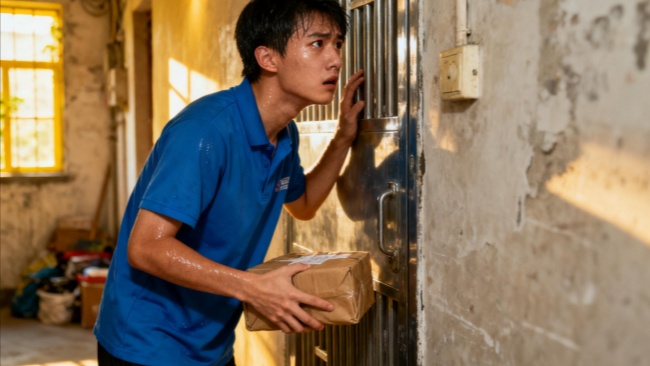

The first knock was normal—firm, professional, the kind of sound that meant a package was waiting on a porch. The second knock came a few seconds later, heavier, as if the man had shifted the box in his arms and decided to try again. The third knock was different.
It was slower.
Three soft taps, evenly spaced, like someone who had stopped expecting an answer but still felt obligated to make sure.
James heard it from the kitchen. He had been standing there for too long, staring at the coffee maker as if it might give him instructions. The house was quiet in a way it had not been quiet for months. No music from the living room. No footsteps upstairs. No voice calling, “Did you take out the trash?”
Just the hum of the refrigerator and the faint rattle of the window above the sink.
He looked toward the front hallway. The blinds were half-closed, and through one narrow gap he could see the courier in a brown uniform, holding a medium-sized box. The label faced away from him. James could not read the name on it, and for some reason, that made his chest tighten.
The courier knocked again.
This time, James moved.
He crossed the kitchen in four steps, his socks sliding slightly on the hardwood. He reached the front door and stopped with his hand hovering over the deadbolt. The brass was cold. He had not touched it all morning.
“Delivery,” the man said.
His voice was muffled through the wood, but clear enough.
James did not open the door.
“I said, delivery for James Calloway.”
The name landed in the hallway like a stone dropped into still water.
James looked down at his hands. He was wearing the same gray sweater he had put on yesterday. The coffee in the kitchen had gone cold. Outside, a neighbor’s sprinkler clicked back and forth across a lawn that had grown too green for August.
“Leave it,” James said.
There was a pause.
“Sir, it requires a signature.”
“I said leave it.”
Another pause. Then the sound of the box being set down on the porch, followed by the soft scrape of a scanner.
“Alright,” the courier said. “It’s there.”
James waited until he heard footsteps moving away, then the van door sliding shut, then the engine pulling off. Only then did he unlock the deadbolt.
The package sat in the center of the porch, square and ordinary. Brown paper. Black tape. A white label with his name printed in clean letters.
James Calloway.
He picked it up carefully, as if it might contain something fragile. It was lighter than he expected.
Inside the house, he carried it to the kitchen table and set it beside the cold coffee. He found a knife in the drawer and sliced through the tape. The flaps opened with a dry crack.
There was only one thing inside.
A blue ceramic mug.
James stared at it.
It was chipped near the handle, just a small white mark where the glaze had broken away. He had seen that chip a hundred times before. He had once told Emily it was ugly. She had laughed and said it gave the mug character.
Under the mug was a folded piece of paper.
James picked it up. The handwriting was hers, slanted and quick, the way she wrote when she was rushing to leave the house.
If you’re reading this, you probably didn’t answer the door right away. You never do when you’re thinking too hard.
This mug showed up at my office last week. I think someone mixed up our addresses, or maybe the store got confused. Either way, it’s yours now. Try not to drop it.
—E
James sat down slowly.
The note was dated six months earlier.
He turned it over, as if there might be more on the back. There was nothing. Just blank paper and the faint smell of lavender, the kind Emily used to keep in a small drawer by the front door.
He looked at the mug again.
He had not ordered it. He had not asked anyone to send it. And the return address on the box had been a warehouse in another state, one he did not recognize.
For a long time, James did not move.
Then he stood, filled the kettle, and set it on the stove. While it heated, he washed the mug in the sink. The water ran warm over his fingers. He dried it with a towel and placed it on the counter.
When the kettle clicked off, he poured the coffee into the blue mug.
Steam curled upward.
James carried it to the window and looked out at the street. The courier’s van was long gone. The sprinkler had stopped. A bird landed on the fence, tilted its head, and flew away.
He took a sip.
The coffee tasted the same as it always did.
But something in the house felt different—smaller, maybe, or less empty. Not fixed. Not healed. Just a little less still.
James looked down at the chip near the handle.
He had always thought it made the mug ugly.
Now, holding it in both hands, he was not so sure.