
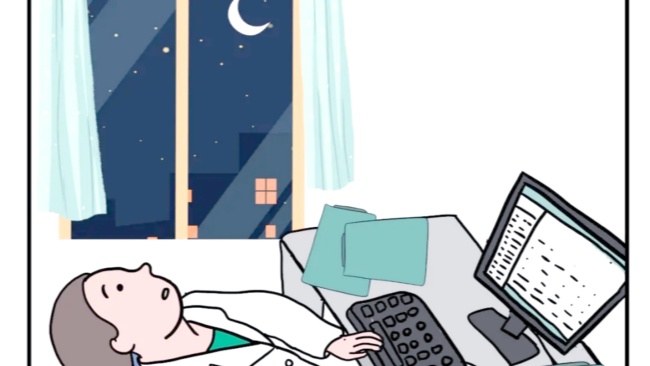

The hospital quieted down around 2 a.m., the way it always did — not truly silent, but close enough that you could hear the hum of the vending machine down the hall and the soft beep of a heart monitor three rooms away.
Emily pulled her phone from her scrubs and opened the Notes app. She had started the habit during her first month on the night shift, when everything felt too fast and too heavy at the same time. At first, the memo was just for herself: reminders, patient updates, small things she didn’t want to forget before morning.
But over time, it became something else.
She typed:
Room 412 — Mr. Calloway. Awake again. Asked if it was snowing.
It wasn’t snowing. It was August, and the parking lot outside looked black and wet under the streetlights. Mr. Calloway had dementia, and some nights he believed he was a young man waiting for a bus in front of his childhood home. Other nights, he thought Emily was his daughter.
She walked into his room with a cup of warm apple juice and sat beside him.
“You’re up late,” she said.
He looked at her with pale blue eyes, confused but calm. “The roads are bad tonight.”
“They’re fine,” Emily said. “You’re safe here.”
He nodded slowly, as if deciding to trust her. Then he pointed to the window. “She’ll be cold.”
“Who?”
“My wife. I told her to wear the blue coat.”
Emily didn’t correct him. She had learned that some memories were not facts to be fixed. They were places people went when the world became too sharp.
Back at the nurses’ station, she added to the memo:
He asked about snow. Blue coat. Wife. Stayed calm after juice.
It wasn’t medical in the usual sense. But it helped her remember what mattered.
Around 3:15 a.m., the hallway lights dimmed automatically, and Emily checked on Mrs. Delaney in Room 418. The older woman was awake, staring at the ceiling, one hand curled around the edge of her blanket.
“Can’t sleep?” Emily asked.
Mrs. Delaney turned her head. “I keep thinking about the letter.”
“What letter?”
“The one I never sent.”
Emily sat down. She should have been charting vitals, but the night had that strange softness to it, the kind that made people say things they usually kept locked away.
“It was to my sister,” Mrs. Delaney said. “We hadn’t spoken in eleven years. By the time I wrote it, she was already gone.”
Emily didn’t know what to say. She had lost people too, though not in the same way. Sometimes grief arrived like a storm. Sometimes it arrived like a letter left unsent, sitting in a drawer for decades, still waiting.
“I’m sorry,” Emily said.
Mrs. Delaney smiled faintly. “Don’t be. I’m not telling you because I want pity. I’m telling you because you’re here.”
That sentence stayed with Emily longer than it should have.
At 4:02 a.m., she opened her phone again.
Room 418 — Mrs. Delaney. Couldn’t sleep. Talked about an unsent letter to her sister.
She stared at the words. Then, below them, she typed:
Sometimes people don’t need answers. They just need someone awake enough to listen.
The rest of the shift passed slowly. A new patient arrived with a broken wrist and a teenage son who looked too tired to cry. A doctor made a joke that nobody laughed at. The coffee machine ran out of cups, and Emily used a paper towel to wipe spilled water from the counter.
By 6:30 a.m., the sky had turned gray-blue, and the day shift began filtering in with their bright voices and clean shoes.
Emily handed off her report, changed out of her scrubs, and stopped in the break room for a glass of water. Her phone buzzed in her pocket. A notification from the Notes app appeared:
Reminder: Mr. Calloway — blue coat.
She almost deleted it. It wasn’t part of any chart, any official record. It was just a fragment of someone else’s night, typed into a phone by a nurse who had been too tired to forget.
Instead, she left it there.
Outside, the morning air smelled like rain. Emily sat in her car for a moment before starting the engine. The hospital behind her looked ordinary in daylight — brick walls, glass doors, a sign pointing visitors toward the main lobby.
But she knew what it looked like at night.
She knew about the man waiting for snow in August. She knew about the woman who had loved someone enough to write a letter too late. She knew that some of the heaviest things people carried did not show up on monitors or in lab results.
Emily started the car and turned on the radio. A soft song played, something about home and distance and time moving forward.
She thought about her own unsent messages — the texts she had typed and deleted, the apologies she had swallowed, the small kindnesses she had almost offered but didn’t.
Maybe tonight she would send one.
Maybe not.
But as she pulled out of the parking lot, she noticed the sky clearing just enough for a thin line of sunlight to break through the clouds. It touched the road ahead, brief and ordinary, as if reminding her that even the smallest light could find its way in if you were willing to look.