

—Dedicated to all little ears that believe in kindness
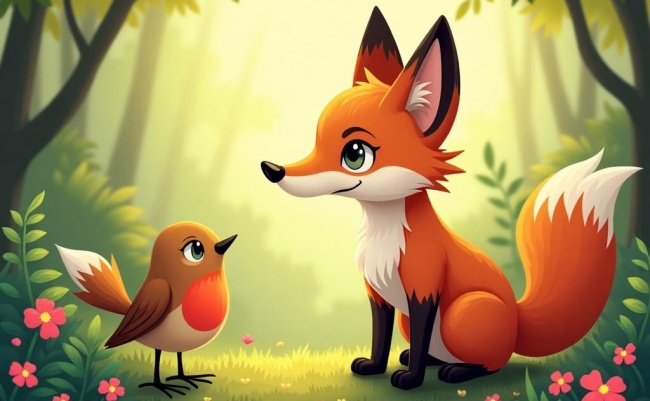
Deep in the oak forest stood a gnarled old oak tree, where a titmouse named Pip made his home. Pip had gray-blue wings and a belly as white as a dollop of butter. He loved nothing more than to perch on the highest branch at dawn and sing a song about dew and sunshine.
Beneath the oak’s roots lay a den built of ferns and soft mud, home to a fox named Fern. Fern’s fur was reddish-brown, with a tuft of white hair at the tip of his tail. His favorite pastime was to crouch at the den’s entrance at dusk, counting the first star to appear in the sky.
Pip and Fern had never spoken to each other.
Because all the birds told Pip, “Foxes eat titmice.”
And all the foxes told Fern, “Titmice are nothing but a snack.”
But Pip noticed that Fern never looked up and bared his teeth while he was singing;
and Fern noticed that Pip never suddenly flew away while he was counting the stars.
One day, the wind blew especially hard, knocking Pip’s little nest askew. Three newly laid eggs rolled down to the base of the tree, right in front of Fenn’s paws.
Pip hopped frantically from branch to branch, his voice hoarse with panic: “My babies! My babies!”
Finn lowered his head and gently nudged the three plump eggs with his nose, then did something no one would have expected—
Using his two front paws, he cradled the eggs one by one as if they were the most precious berries, supported them with his tail, and climbed step by step up the crooked tree, gently placing them back in Pip’s nest.
Pip was stunned.
He fluttered his wings, picked up the reddest raspberry from the nest, placed it on the edge of a branch, and nudged it toward Fain.
Fain thought for a moment, curled the raspberry up with his tongue, swallowed it, then wagged his tail—it was a fox’s smile.
From then on, every evening, Pip would sing a newly learned song; every evening, Fenn would sit under the tree, his tail coiled around his paws, listening quietly.
Occasionally, Pip would fly down and perch on the tip of Fenn’s nose to help him pluck a grass seed from behind his ear.
Occasionally, Fenn would raise a paw to shield Pip from a sudden gust of cold wind.
The other animals found this strange.
The owl blinked her big eyes and asked, “Why aren’t you afraid?”
Pip said, “Because he reached out his paw first, but he didn’t grab me—he cradled my baby instead.”
Finn said, “Because she pushed the raspberry toward me first, but she didn’t fly away—she stayed perched on the tip of my nose.”
After that, every summer night, a circle of little animals—little rabbits, little shrews, little hedgehogs—would gather under the old oak tree.
Pip stood on top of Fain’s head, and Fain lay flat so everyone could see.
After Pip finished singing, Fain would tell a story in a deep voice, and the story always began:
“Once upon a time, there was a titmouse and a fox who didn’t know the word ‘impossible’ existed in the world…”
As the little animals slowly drifted off to sleep, Pip would gently peck at Fenn’s ear, and Fenn would blink softly.
Moonlight streamed down, and the shadow of the Crooked-Neck Tree fell just over the two of them, like a gentle embrace.
And the next morning, Pip sang as usual, and Fain counted the stars as usual.
But deep down, they both knew—
The best thing in the world isn’t to eat each other, but to listen to each other until the end.
Good night, Little Ears.
May you, too, meet someone willing to hold your precious self close.
Even if he’s a fox, and you’re a titmouse.