
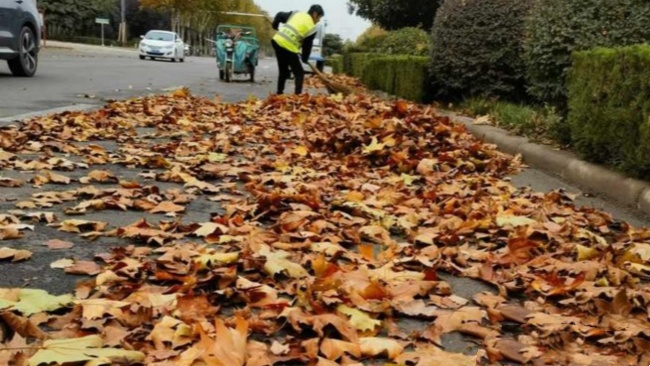

Every morning at 5:47, James Harrison pushed his broom down Maple Street. Same route. Same rhythm. Same rustle of dry leaves skittering across cracked asphalt.
He had been a sanitation worker for nineteen years. His hands were callused, his back perpetually sore, and his mind—well, his mind had learned to wander while his body worked. That was the trick. Let the arms swing. Let the broom hiss. Let the brain drift somewhere far away from the smell of damp garbage and the weight of another Tuesday.
This Tuesday, however, his brain snapped back sharply.
Thump.
Not the soft shush of oak leaves. Not the gritty scrape of gravel. A heavier sound. A hollow, papery thud.
James stopped and nudged the small pile he’d gathered. A cream-colored envelope lay half-buried beneath a maple leaf, its surface spotted with dew. He bent down—his knees popping in protest—and picked it up.
The envelope was addressed in looping, elegant handwriting:
To the one who sweeps.
No street. No name. Just that.
James turned it over. Unsealed. The flap was tucked in, not glued. He hesitated for exactly three seconds, then slid his thumb beneath the fold and pulled out a single sheet of matching cream paper.
Dear Sweeper,
If you’re reading this, you found it before the rain. I’m glad.
I’ve been watching you for three months now. You always pause at the oak tree with the crooked branch. You always stretch your back at the same spot, right where the streetlamp flickers. You always pick up the crushed soda can and put it in your cart instead of sweeping it into the gutter.
I don’t know your name. But I know you have a daughter. I see her walk with you sometimes, on Saturdays, her pink backpack bouncing. You let her push the broom for one block. She laughs. You laugh too. It’s the only time you sound young.
I’m writing because I want you to know: someone notices.
Not the city council. Not the passing cars. Not the woman who walks her dog and never says hello.
Me. I notice.
I leave this letter in the leaves because I want you to have something that isn’t garbage. Something that wasn’t thrown away. Something chosen.
Tomorrow, look up. Look at the third window from the left, above the bakery. I’ll be there. I’ll wave. You won’t know me—but I’ll know you.
And I’ll leave another letter, same place, same time, until you decide if you want to know me back.
With gratitude,
A Neighbor
James read it twice. Then a third time.
His first instinct was suspicion. A prank. A setup. Some bored teenager with a phone, filming for social media. He glanced up at the bakery building—a tired brick facade with peeling yellow paint. The third window was dark, curtains drawn.
He folded the letter carefully, tucked it into his breast pocket, and finished his route in silence.
The next morning, he swept slower.
He paused at the oak tree. No envelope. He kept sweeping, but his eyes kept drifting to that third window. Still dark.
At 6:12, just as he was about to give up, he heard a soft click. The window swung open, and a woman appeared. Not young. Not old. Maybe sixty. Silver hair pulled back, glasses perched on her nose. She held a steaming mug and lifted it—a toast. To him.
Then she smiled, pointed down, and mouthed two words: Keep sweeping.
James looked at his feet. There, half-hidden beneath a wet magnolia leaf, lay another cream envelope.
He opened it right there, not caring who saw.
Dear Sweeper,
Today I’ll tell you something true: I used to sweep too. In a different city, thirty years ago. I swept outside a hospital. Every morning, I’d see a young doctor walk in—always tired, always carrying too many files. One day, I left a note in a pile of leaves. Just three words: “You look tired.”
The next week, he left a note back. “I am. But thank you.”
We wrote to each other for two years. I never learned his name. He never learned mine. But I fell in love with his handwriting, his humor, the way he ended every note with “Stay warm.”
Then I got transferred to another route. I never saw him again.
But I learned something: The people we never meet can still change us. The letters we leave—even in leaves—matter.
So I’m leaving this one for you. No strings. No meeting. Just a reminder: You’re not invisible.
You are the first beautiful thing I see every morning.
—Your Neighbor
James folded the letter and stood very still.
The street was quiet. A delivery truck rumbled past. A pigeon pecked at something near the curb. Normal morning sounds. Normal morning sights.
But something in his chest had shifted. Some small, rusty hinge had oiled itself.
He looked up at the third window. She was still there, sipping her coffee. She raised her hand, a gentle wave.
James didn’t wave back. He just nodded once, slowly, and pressed his palm to his chest—right where the letters sat.
Then he picked up his broom and kept sweeping.
The leaves rustled. The cart wheels squeaked. And for the first time in nineteen years, James didn’t let his mind wander.
He stayed right there. Present. Seen.
And when he finished his route, he reached into his pocket, pulled out a scrap of paper, and scribbled a single line.
Tomorrow, he’d tuck it beneath the oak tree.
“Stay warm.”
The third window stayed open a little longer that morning. And James, for the first time in years, didn’t just sweep the leaves away—he let himself feel the weight of them, soft and small, like a hand pressed gently to his chest.
Somewhere, without a word exchanged, a quiet connection had formed. Not quite a friendship. Not quite a story. Just a shared understanding that even the quietest routines are witnessed, and that being seen, even by a stranger, has a way of making the ordinary feel suddenly, strangely precious.
He didn’t know her name. She didn’t know his.
But the letters would keep coming. And that was enough.