
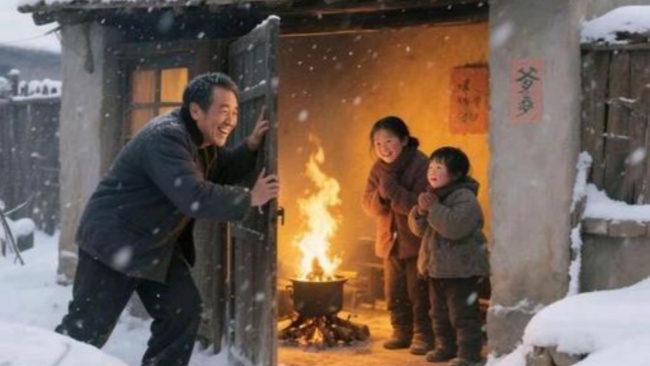

The snow had been falling since four in the afternoon, and by nine, James could no longer see the road from his kitchen window.
He liked that. He had moved to the edge of Maple Creek two years earlier because he wanted fewer conversations, fewer phone calls, and fewer reasons to explain himself. The house was small, the woodstove burned well, and the nearest neighbor lived a half mile down the hill.
James was washing a single plate when the knocking came.
Three slow knocks. Not loud, not panicked—just steady, like someone who had time and intended to use it.
He turned off the faucet and listened.
The wind moved through the pines. The stove ticked as it cooled. Then came the knocking again.
James glanced at the clock: 9:17 p.m.
He did not own a dog, but if he had, it would have barked. Instead, the house felt too quiet, as if it were holding its breath.
He walked to the front door and looked through the peephole.
An old man stood on the porch, snow caught in his gray beard and the folds of a dark wool coat. He wore no hat. His hands were bare, and one of them held a small leather satchel.
James hesitated.
Every sensible thought told him not to open the door. But the man did not look dangerous. He looked cold. Worse than cold—he looked like someone who had been walking for a long time and had almost forgotten why.
James opened the door a few inches.
The wind pushed in with a sharp breath of snow.
“Sorry to bother you,” the old man said. His voice was rough, but gentle. “My car went off the road near the ridge. I don’t need much. Just a place to sit until the storm slows.”
James studied him. “Where’s your phone?”
The old man gave a small, tired smile. “Dropped it in the snow. Or maybe it died. I stopped checking.”
That answer should have made James more suspicious. Instead, it made him step aside.
“Come in.”
The old man entered carefully, as if afraid to bring too much of the storm with him. He stood in the hallway, snow melting from his coat, and looked around the way people look at places they used to know.
“Nice home,” he said.
“It’s fine,” James replied.
He led the man to the kitchen, poured him a mug of coffee, and set it on the table. The old man wrapped both hands around it and stared into the dark liquid.
James sat across from him. “What’s your name?”
“Arthur.”
“James.”
“Thank you, James.”
For a while, neither of them spoke. The coffee steamed between them. Outside, the snow pressed against the windows like it wanted to be let in.
Then Arthur said, “You live alone out here.”
It was not a question.
James shrugged. “I like the quiet.”
Arthur nodded slowly. “Quiet is good. But sometimes it gets loud in its own way.”
James looked up.
The old man’s eyes were pale blue, faded at the edges, but sharp in the center. James had the strange feeling that Arthur was not talking about the house.
“I lost my wife,” James said before he could stop himself. “Two winters ago.”
Arthur did not offer pity. He only said, “That changes the shape of a place.”
James swallowed. “It does.”
Arthur reached into his satchel and placed a small wooden box on the table. It was plain, with no markings, and it smelled faintly of cedar.
“I make these,” Arthur said. “Small boxes. For things people don’t want to lose.”
James looked at it. “What kind of things?”
Arthur smiled again, but this time it was sadder. “The kind that don’t weigh much until you set them down.”
James did not know what to say. He reached for the box and opened it.
Inside was a silver button.
It was simple, scratched at the edge, with four small holes in the center. James stared at it, and something in his chest tightened.
He had seen that button before.
Not this exact one, maybe. But one like it. On a coat his wife used to wear when they walked through town in December. She had complained that it always came loose. He had promised to sew it back on properly. He never had.
James closed the box.
His throat felt narrow. “Where did you get this?”
Arthur’s face softened. “I didn’t. Not from her. Not exactly.”
James frowned. “Then where?”
Arthur looked toward the window, where the snow had turned the world into a blank page.
“I think,” he said, “some doors are knocked on because something inside needs to be heard.”
James wanted to argue. He wanted to say that was nonsense, that a man does not appear out of a storm with a box and a story that fits too well. But the kitchen was warm, the coffee was still hot, and for the first time in two years, the silence in the house did not feel empty.
It felt like someone had finally sat down at the table.
Arthur stayed until midnight. They did not talk much after that. James found a blanket for him and let him rest by the stove. Sometime after eleven, the wind died down, and the snow stopped falling.
When James woke the next morning, the chair by the stove was empty.
The blanket was folded neatly. The mug was washed and set beside the sink. The front door was closed, and Arthur’s footprints led down the porch steps before disappearing under fresh snow.
James stood there for a long time.
Then he went to the kitchen table.
The wooden box was still there.
He opened it. The silver button lay inside, small and ordinary, catching the pale morning light.
James held it in his hand for a while. Then he walked to the hall closet, found an old coat he had not worn since the winter his wife died, and sat down on the floor beside it.
He did not cry the way he expected to. It was quieter than that—like a window finally opening after being stuck for years.
Outside, the snow had stopped. The road would be clear by afternoon. Arthur’s car, if there had been one, was nowhere to be found. James told himself he must have gotten a ride, or walked to the main highway, or simply left before dawn.
He almost believed it.
Later, when he hung the coat back in the closet, he noticed the bottom button was missing.
James stared at the empty thread.
Then he took the silver button from his pocket, placed it against the coat, and began to sew.