

The automatic doors of County General’s emergency room parted with a tired sigh, and James nearly walked past the old man sitting on the curb.
Nearly.
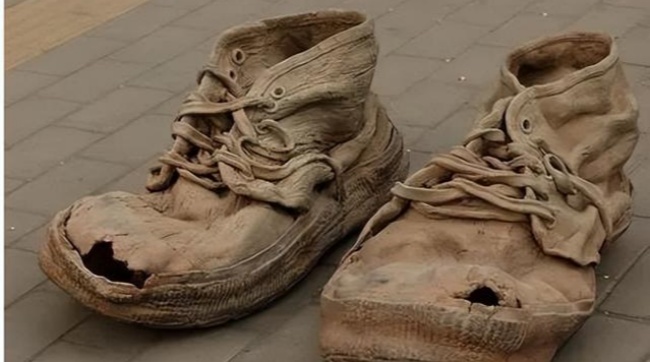
What stopped him was the shoes. Black canvas slip-ons, the kind you’d find in a dollar bin at a discount store, worn through at both toes. You could see the gray socks underneath — one of them darned with clumsy, uneven stitches. The rubber soles had split along the sides like old riverbanks, and the left shoe was held together by a strip of duct tape so faded it had turned the color of weak tea.
James had been an ER nurse for eleven years. He’d learned to read people the way mechanics read engines — by the sounds they made when something was breaking. The way a father gripped his daughter’s hand. The tremor in a teenager’s voice. The particular stillness of someone who’d already decided the answer would be bad.
The old man wasn’t still. He was rocking. Back and forth, hands laced over one knee, staring at the doors as if willing them to open wider.
“Sir?” James said, crouching down. “Are you waiting for someone?”
The man looked up. His face was a topographic map of deep creases and sun damage, the kind that comes from decades of outdoor work. His eyes, though, were sharp — pale blue and restless.
“My wife,” he said. “Dorothy. They took her in about an hour ago. Ambulance.”
James checked his watch. 2:17 a.m. “Do you have her name?”
“Dorothy Calloway. She’d be seventy-three.”
James straightened. “Let me go check on her, Mr. Calloway. What’s your name?”
“Frank.”
“I’ll be right back, Frank.”
Inside, the ER hummed with its usual midnight chaos. A drunk with a split lip argued with a security guard near the front desk. A young mother bounced a feverish toddler on her hip, whispering something that might have been a prayer. James threaded through it all, found the charge nurse’s station, and looked up the admission.
Dorothy Calloway. Bay 7. Stroke alert, arrived 1:04 a.m.
James felt the familiar weight settle in his chest. He’d seen this story before — the sudden phone call, the ambulance lights cutting through a quiet evening, the spouse left behind on the curb because no one had thought to tell them they could come inside.
He went back out.
“Frank,” he said gently. “I found her. She’s awake, and she’s stable. They’re running some tests.”
Frank’s hands loosened. Just slightly. “Can I see her?”
“Yeah. Come on.”
Frank stood slowly, and James noticed then how thin he was — how the flannel shirt hung off his shoulders like it belonged to someone bigger. He walked with a careful limp, favoring his right side, and James realized the duct-taped shoes weren’t just old. They were all he had.
In Bay 7, Dorothy lay propped against the pillows, an IV in her left arm and a heart monitor tracing steady green peaks across the screen. When she saw Frank, her face crumpled and reassembled itself into a smile in the span of a single breath.
“You came,” she said.
“Of course I came.” He sat on the edge of the bed and took her hand. “You scared me, Dot.”
“I scared myself.” She looked at James. “Thank you for getting him.”
James nodded and stepped back toward the curtain. That’s when he saw it — the way Frank’s hand covered Dorothy’s, and the way her fingers curled around his like she was afraid he might disappear. The shoes sat beneath the bed rail, side by side, and from this angle James could see the duct tape had been applied carefully, almost neatly, as if someone had taken time to make the repair hold.
He pulled the curtain halfway shut and went back to work.
At 4:30 a.m., the ER quieted to its low, persistent murmur. James was charting in Bay 3 when he heard a voice behind him.
“Excuse me.”
Frank stood there holding two paper cups of coffee from the vending machine. He offered one to James.
“You don’t have to —”
“I know,” Frank said. “But you went and got me when you didn’t have to. Nobody does that anymore.”
James took the coffee. It was terrible — burnt and thin — but he drank it anyway.
They stood there for a moment in the fluorescent half-light, two strangers connected by a woman in Bay 7 and a pair of shoes that had walked farther than they had any right to.
“She’s going to be okay,” James said.
Frank nodded. “I know.”
He turned to go back to her, and James watched him walk away — that careful, uneven step, the worn canvas shoes scuffing softly against the linoleum. They were ugly shoes. They were falling apart. But they had carried him here, through whatever distance and whatever years, to the place where she was waiting.
James looked down at his own shoes — clean white sneakers, barely three months old, already showing a crease across the toe. He thought about all the things he’d walked away from because they were inconvenient, or uncomfortable, or simply too much trouble.
Then he finished his coffee, walked back to Bay 7, and sat down with Frank until the sun came up.